
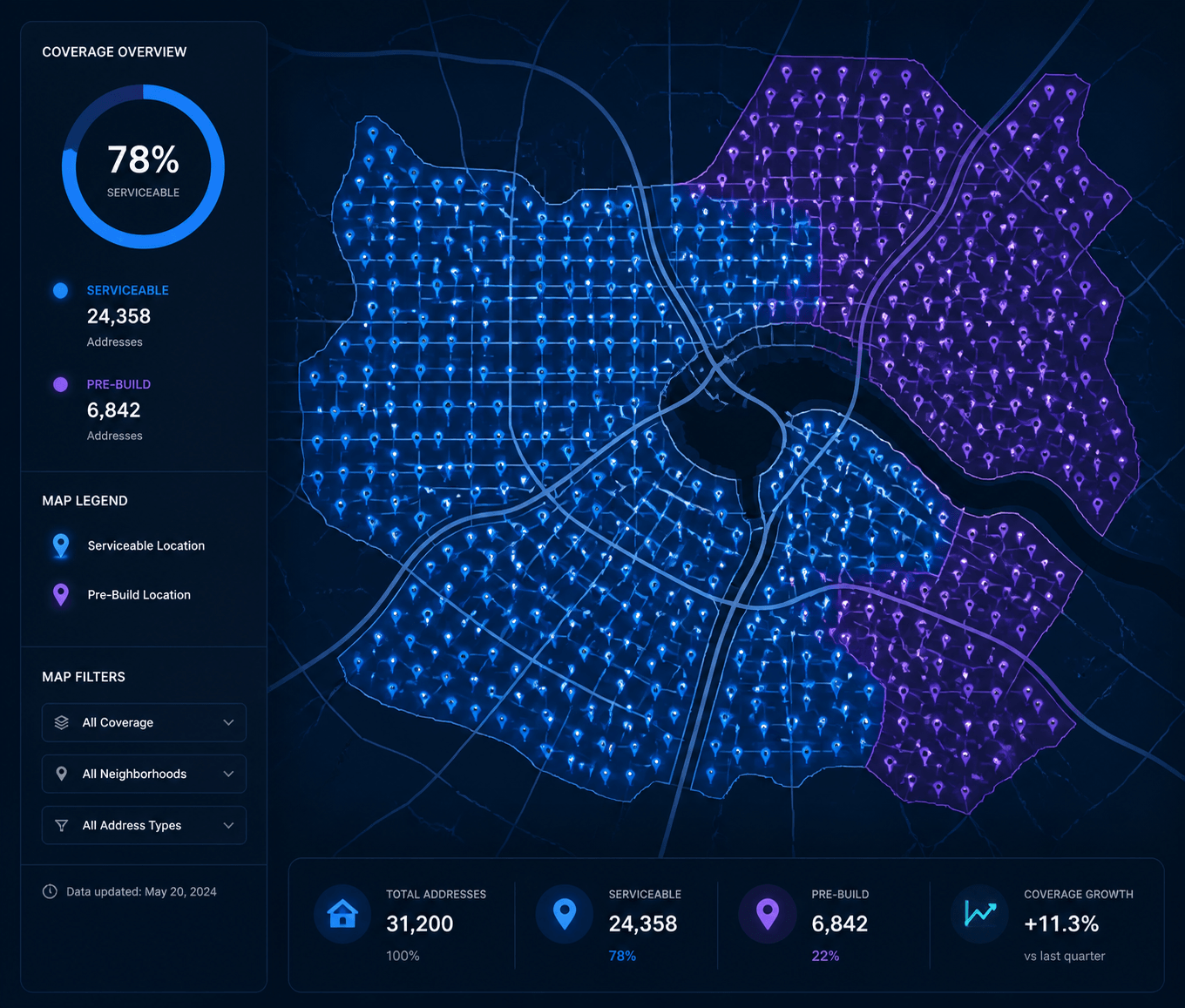
Ask most broadband operators where their network build goes wrong, and they won't point to construction. They'll point further back, to the fiber network mapping data they built on top of.
For years, the standard playbook for a new fiber deployment has been broadband demand aggregation first: run a marketing campaign, collect pre-registrations, and use that signal to decide where to build. It's an intuitive approach, and it isn't wrong exactly. It's just incomplete. Demand aggregation only works if it's built on top of something solid, and that something is accurate location data. Skip that step, or treat it as an afterthought, and every decision made downstream, sales territories, construction sequencing, funding compliance, inherits the same errors.
The foundation problem
Here's the issue in plain terms: you can't aggregate demand for addresses you don't know exist, and you can't trust demand signals for addresses that shouldn't be counted at all. Multidwelling units get undercounted. New construction gets missed. Serviceable and pre-build areas get blurred together. None of this shows up as a dramatic failure on day one. It shows up months later, as a sales team chasing the wrong territory, a construction crew building past addresses that were never really serviceable, or a funding report that doesn't reconcile with what the Broadband Serviceable Location Fabric says should be there.
That last point matters more in 2026 than it did a few years ago. With $42.45 billion in BEAD funding now flowing to operators across the country, and nearly every state and territory carrying an approved final proposal, accurate serviceable location data isn't just good practice anymore. It's tied directly to how a network gets funded, reported, and audited. An operator building on flawed mapping data isn't just making a marketing mistake. They're building a compliance problem into the foundation of the project.
Plan comes before Sell, not after
At AEX, we think about a fiber network's life in six stages: Plan, Build, Sell, Install, Activate, and Run. The order isn't arbitrary. Plan comes first because everything else depends on it. Coverage planning, serviceable location mapping, and build-versus-pre-build classification are what turn a coverage map into something a sales team can actually act on. Skip that step, or treat it as a checkbox before the "real" work of demand aggregation begins, and the sales, construction, and activation stages that follow are all working from the same bad map.
Most vendors sell you one of these six stages, occasionally two. That's part of why the industry defaults to demand aggregation as a starting point. It's the stage that's easiest to buy off the shelf. But a sales territory built on inaccurate premise data doesn't get more accurate because the marketing around it is good. It just fails more expensively, later, once trucks and technicians are already committed.
What this looks like when it's done right
Ripple Fiber is a useful example, not because it's a testimonial, but because it's an outcome. Ripple started as a 13 person team with a mandate to build fiber and no operational infrastructure of its own: no NOC, no helpdesk, no carrier network, and no coverage planning function to sort serviceable addresses from everything else. Running its full operations on AEX from day one, including the mapping and classification work that comes before a single sales conversation, Ripple grew into a 10 state operator passing more than 250,000 homes, doubling both its footprint and its customer base year over year.
None of that growth started with a demand campaign. It started with knowing, address by address, where the network could actually go.
That discipline scales past one operator. AEX manages more than 300 PoPs across a 14-state footprint today, and every one of them traces back to the same premise-level accuracy that Ripple's build started with. Accurate mapping isn't a one-time setup step. It's the layer that has to hold up as a network goes from a handful of sites to hundreds of them.
The takeaway
A serviceable address becomes a sales territory. A sales territory becomes a construction plan. Nobody in the middle has to guess. That's the sequence that actually holds up, and it only works if the first link in the chain is solid.
Demand aggregation still matters. Knowing where people want service helps prioritize a build and make the case for funding. But it's a second step, not a first one. The operators who get this right are the ones spending their effort on accurate mapping before they spend it on demand, because a network built on the wrong addresses doesn't get fixed by better marketing. It gets fixed by starting over.
If you're planning a build, whether it's a BEAD funded project or a private expansion, the question worth asking isn't "how do we generate demand." It's "how do we know, with confidence, where we can actually build." Get that answer right, and everything downstream gets easier.
FAQs
What is demand aggregation in broadband deployment? Demand aggregation is the practice of collecting pre-registrations or expressions of interest from potential subscribers, usually through a marketing campaign, to gauge and prove demand before or during a fiber build. It's often used to prioritize which neighborhoods get built first.
Why isn't demand aggregation enough on its own? Demand aggregation only measures interest at addresses an operator already knows about. If the underlying mapping data is incomplete or inaccurate, whole categories of serviceable properties, MDUs especially, get missed or miscounted before a single demand campaign even runs.
What is the Broadband Serviceable Location Fabric, and why does it matter for BEAD? The Broadband Serviceable Location Fabric is the FCC's national dataset of serviceable locations, and it's the reference data BEAD grantees are measured against for funding and reporting. A network built on mapping data that doesn't reconcile with the Fabric can run into compliance problems, not just marketing ones.
Should an operator skip demand aggregation entirely? No. Demand aggregation is still useful for prioritizing a build and making the case for funding. It just isn't the first step. Accurate mapping and serviceable location data need to be in place before demand aggregation is layered on top, otherwise the demand signal itself is unreliable.
How does AEX help operators get the mapping step right? AEX's Plan stage covers GIS coverage analysis, serviceable location mapping, and build-versus-pre-build classification before a sales team ever engages a customer. It's the same foundation that scaled Ripple Fiber to a 10-state operator and that underpins the 300+ PoPs AEX manages across its footprint today.