Every fiber network eventually runs into the same wall. You can build a beautiful last-mile network, get homes lit, and start signing up subscribers, but none of that traffic goes anywhere without a way to move it off your network and onto the wider internet. That's carrier services: the backbone and middle-mile infrastructure that connects your network to everything beyond it.
It's the part of the business most new operators didn't budget time to think about, because it isn't visible to subscribers the way a fast connection or a good install experience is. But get it wrong, or get it started too late, and it becomes the bottleneck that undoes everything else you built.
What carrier services actually cover
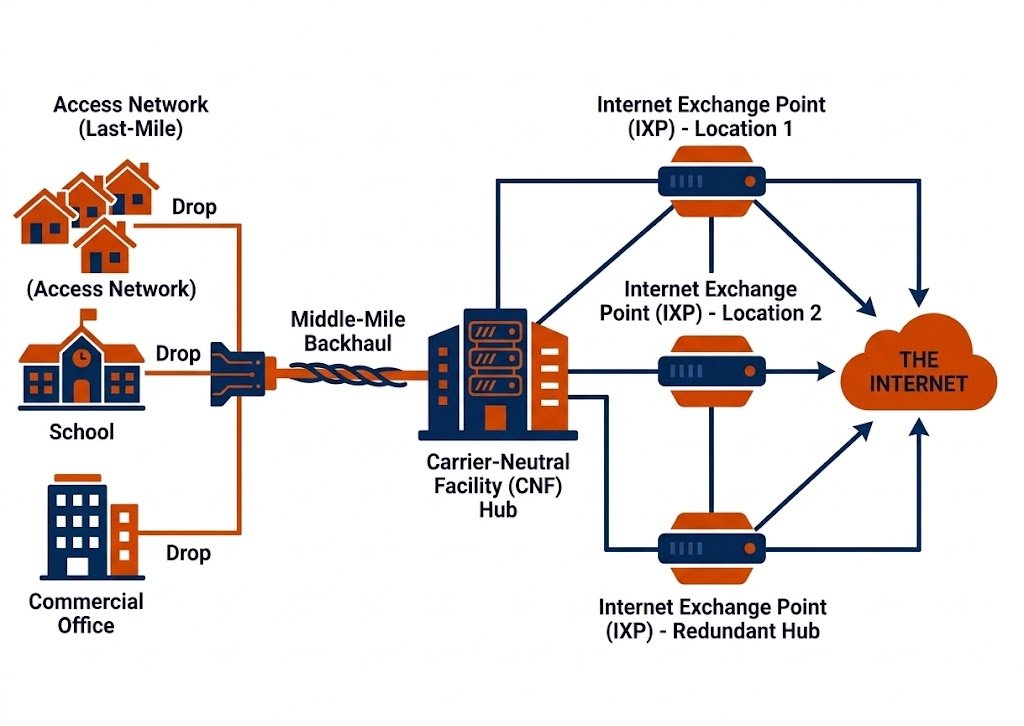
Carrier services sit between your access network (the fiber running to homes and businesses) and the internet at large. Concretely, that means a few distinct pieces of infrastructure working together.
A national dark-fiber backbone is the physical long-haul fiber that carries traffic between markets. Most operators don't own this end to end. They lease capacity on existing backbone routes rather than building their own cross-country fiber, which would take years and capital most fiber operators don't have sitting around.
Middle-mile backhaul is the connection between your local access network and that backbone, usually built as point-to-point or point-to-multipoint circuits. This is the piece that's most often specific to your footprint, since it has to physically reach wherever your network is.
Carrier-neutral facility access matters more than it sounds. These are data centers where multiple carriers, cloud providers, and networks physically interconnect, and operators need presence at enough of them to reach traffic efficiently rather than routing everything through a single point that becomes both a bottleneck and a single point of failure.
Internet exchange access is what actually gets your traffic onto the internet, typically through direct interconnection at those same carrier-neutral facilities rather than through a single upstream provider.
Dedicated Internet Access, sold in 1G, 10G, and 100G increments, is the actual bandwidth product operators buy to move traffic at the volumes a growing subscriber base demands.
Why operators outsource this instead of building it themselves
The economics rarely favor doing it alone. Backbone and carrier-neutral facility relationships take years to build and require negotiating and maintaining contracts across markets you may not have local expertise in yet. A newer or midsize operator trying to negotiate its own carrier agreements is negotiating from a position of low volume, which means worse pricing than an aggregator who's already buying at scale across many operators.
There's also a timing problem specific to growing operators. Capacity needs change as you add markets and subscribers, and building your own backbone relationships means each new market is its own multi-month procurement project. A managed carrier services model, where middle-mile backhaul, exchange access, and dedicated internet access are already in place across a footprint of carrier-neutral facilities, means new capacity is available on demand rather than subject to a build schedule.
AEX's own carrier services run this way: a national dark-fiber backbone with 100Gbps equipment across 10 carrier-neutral facilities in 14 states, including Equinix, Digital Realty, CoreSite, 123Net, and TierPoint. Point-to-point and point-to-multipoint middle-mile backhaul reaches into operator footprints, direct internet exchange access is available at all 10 nodes, and Dedicated Internet Access at 1G, 10G, and 100G is provisioned at all of them. Because that capacity is already built out rather than provisioned on request, it's available now, not something an operator waits on while a new market ramps up. It works alongside Virtual ISP and equipment procurement as the three pieces that round out a fully managed network operations offering.
What to actually evaluate
If you're deciding whether to build carrier relationships yourself or use a managed provider, a few questions matter more than raw price per megabit.
How many carrier-neutral facilities does the provider actually have presence in, and do they overlap with where you operate or plan to expand? A provider with two facilities on the other side of the country from your footprint isn't solving your middle-mile problem.
Is capacity actually available now, or does it require a new build every time you add a market? This is the difference between carrier services that scale with you and carrier services that become a recurring procurement bottleneck.
What's the redundancy story? A single upstream connection, however fast, is a single point of failure. Multiple exchange points and diverse backbone paths matter more once you have paying subscribers depending on uptime.
Carrier services aren't the part of the business that wins subscribers. But they're the part that determines whether the network you built to win those subscribers actually works reliably once they're on it, and it's usually cheaper and faster to get right by leaning on a provider who's already built the relationships than by building them from scratch.
FAQ
What's the difference between carrier services and an ISP?
An ISP sells internet access to end users. Carrier services are the wholesale infrastructure, backbone, middle-mile, and interconnection, that gets traffic from a network operator's footprint to the broader internet in the first place. A fiber operator is a customer of carrier services, not a substitute for them.
What is middle-mile, specifically?
Middle-mile is the fiber connection between an operator's local access network and the long-haul backbone that carries traffic between cities and regions. It's called "middle" because it sits between the last mile (to the home) and the backbone (across the country).
Why does facility location matter for carrier services?
Carrier-neutral facilities are where interconnection actually happens. If a provider's facilities don't overlap with your operating footprint, your traffic has to travel farther to reach one, adding latency and cost. Overlap between provider footprint and operator footprint is one of the more overlooked factors in choosing a carrier services partner.
Can a growing operator switch from self-managed to managed carrier services later?
Yes, and it's common. Many operators start with a single upstream provider in their home market and move to a managed multi-facility model once they expand into new markets and the procurement overhead of negotiating each new relationship starts slowing growth down.
What does Dedicated Internet Access mean in this context?
It's a guaranteed, symmetrical bandwidth connection (as opposed to shared or best-effort), sold in fixed increments like 1G, 10G, or 100G. It's the actual product operators purchase to move subscriber traffic at volume.