
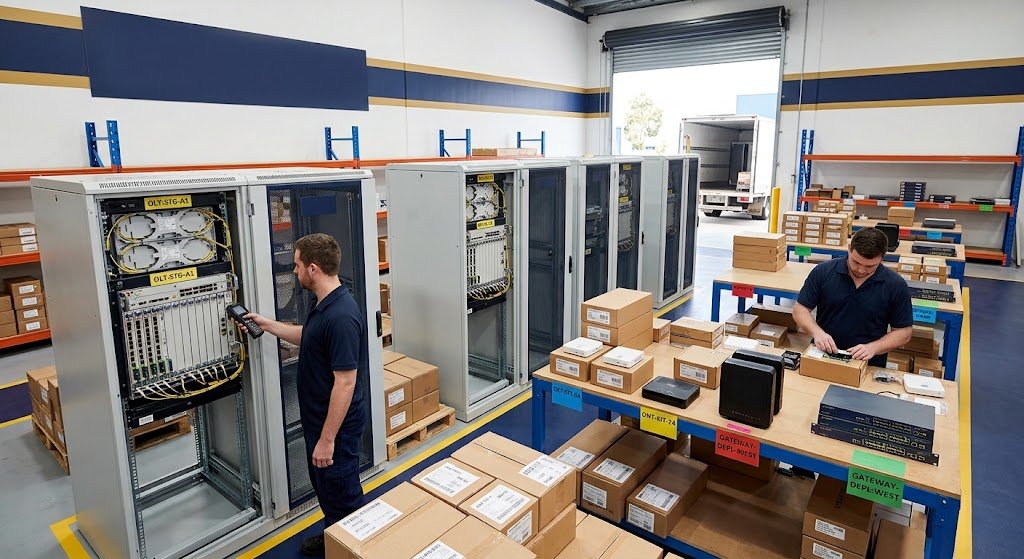
Every fiber network runs on hardware that has to be sourced, staged, and delivered in the right sequence to keep a build on schedule. Optical line terminals at the head end, optical network terminals at the customer premises, gateways in the home, cabinets in the field. It sounds like a purchasing function, and technically it is, but treating it like a simple purchase order is where a lot of operators run into trouble, especially when launching a new network for the first time.
What equipment procurement actually covers
At the core, it's OLT and ONT sourcing. Optical line terminals sit at the head end and manage the fiber connections out to customers; optical network terminals sit at the customer premises and terminate that fiber. These come from a small set of established vendors, Nokia, Calix, and others, spanning technology generations from GPON through the newer 25GS-PON standard, and the right generation for your network depends on the density and bandwidth commitments you've actually made to subscribers, not just what's newest.
Beyond the head-end and premises equipment, there's the customer-facing hardware: Wi-Fi 6E gateways and mesh systems, including consumer brands like Eero, that determine what the actual in-home experience looks like regardless of how good the fiber connection to the house is.
Then there's the infrastructure most subscribers never see: street cabinets, broadband network gateways (BNGs), CGNAT appliances, switches, patch panels, and power systems that keep all of it running. None of this is optional or deferrable, it has to be in place before a market goes live, and it has to be sized correctly for the subscriber counts you're planning for, not just the ones you have today.
Why this becomes a bottleneck if it's not planned early
The core problem with equipment procurement is timing, not sourcing. Fiber infrastructure supply chains have genuinely been under strain industry-wide. Normal lead times for fiber-related supply that used to run eight to twelve weeks have stretched toward a year in parts of the industry, driven by demand pressure from multiple directions at once, including BEAD-funded buildouts. An operator that starts sourcing equipment only once a market's construction schedule is finalized is often sourcing too late to hit their own go-live date.
There's also a vendor relationship problem. Buying equipment through authorized channels rather than gray-market resellers matters for warranty coverage, firmware support, and the ability to get replacement units quickly when something fails in the field. That kind of channel relationship, like carrier relationships, takes time to establish and works better at scale than it does for a single operator buying in small quantities.
And there's a coordination problem specific to fiber builds: equipment delivery has to line up with the construction and commissioning schedule. Equipment that arrives too early sits in a warehouse depreciating and tying up capital. Equipment that arrives too late delays a market's go-live regardless of how well the physical fiber build went. Staging and delivery coordinated with commissioning, not just "get it there eventually," is what actually keeps a build on schedule.
How AEX's equipment procurement approach handles this
AEX Network Services runs equipment procurement through authorized vendor channels across the full stack an operator needs: OLTs and ONTs from Nokia, Calix, and other established vendors spanning GPON through 25GS-PON, Wi-Fi 6E gateways and mesh systems including Eero, and the supporting infrastructure, street cabinets, BNGs, CGNAT appliances, switches, patch panels, and power systems. Staging and delivery are coordinated directly with each market's commissioning schedule, rather than shipped on a generic timeline and left for the operator to sequence themselves. It works alongside Virtual ISP and carrier services as the three pieces that round out a fully managed network operations offering.
What to ask before you commit to a procurement approach
A few questions are worth working through before deciding whether to manage equipment procurement in-house or through a managed provider.
-
What's the actual lead time on the specific hardware generation you need, and does your construction schedule assume that lead time or ignore it? A lot of go-live delays trace back to this gap rather than anything wrong with the physical build.
-
Are you buying through channels that protect your warranty and firmware support, or through whoever quoted the lowest price this quarter? The second option tends to get expensive the first time a batch of ONTs needs a firmware fix and support won't touch gray-market units.
-
Who's actually coordinating delivery against your commissioning schedule? If the answer is "we'll figure it out when it gets close," that's usually the point where equipment sits in a warehouse or a market's go-live slips.
Equipment procurement isn't glamorous, but it's one of the more common places a well-planned fiber build actually loses time. Getting the sourcing, channel relationships, and delivery coordination right early is usually cheaper than fixing a delayed launch later.
FAQ
What's the difference between an OLT and an ONT?
An OLT (optical line terminal) sits at the network head end and manages fiber connections out to customers. An ONT (optical network terminal) sits at the customer's premises and terminates that fiber connection. They work as a matched pair across a PON (passive optical network) architecture.
What is 25GS-PON, and do I need it?
25GS-PON is a newer PON standard offering significantly higher symmetrical bandwidth than GPON, the older, more widely deployed standard. Whether you need it depends on the bandwidth commitments you're making to subscribers and your network's density, not simply on it being the newest option.
Why does equipment lead time matter so much for fiber builds?
Fiber infrastructure supply chains have been under real strain industry-wide. Equipment sourced late in a build can push back a market's go-live date independent of how the physical construction is going.
What's the risk of buying fiber equipment outside authorized vendor channels?
Gray-market or unauthorized-channel equipment often loses manufacturer warranty coverage and firmware support. When a batch of field units needs a firmware update or a warranty replacement, that gap becomes an operational cost, not just a compliance issue.
How does staging and delivery coordination actually work?
Rather than shipping equipment on a fixed generic timeline, staging is scheduled against each market's specific commissioning date, so hardware arrives close enough to go-live to avoid warehousing costs but early enough that installation crews aren't waiting on it.