Every broadband operator knows the feeling. A subscriber calls in. Something is wrong. The agent picks up, pulls up the account, and immediately starts opening tabs.
One for billing. One for the network portal. One for service history. Sometimes a fourth for open work orders.
By the time they have pieced together a full picture of that customer, the caller has already been on hold for two minutes, and the agent has not even started to solve the problem.
This is not a people problem. It is a tools problem. And for growing fiber operators, it is one of the most expensive inefficiencies hiding in plain sight.
The real cost of fragmented customer data
Industry research makes it clear: employees spend up to 30% of their workday searching for information across systems. The average digital worker switches between applications nearly 1,200 times a day. In a support environment, that number is almost certainly higher.
The downstream effects go well beyond slow handle times. Agents working across disconnected systems make more errors, escalate more often, and miss upsell opportunities because the billing view and service view live in different places. Customers feel every second of that friction.
For a fiber operator managing thousands of subscribers, this is a structural drag on team performance, customer satisfaction, and revenue growth. And it compounds as you scale. The same fragmentation that slows a 5,000-subscriber operation becomes a serious revenue leak at 50,000 -- and it is the same underlying problem that creates billing confusion, poor collections, and rising churn rates that operators across every growth stage face.
What a 360-degree view actually requires
The term gets used a lot. Most of the time it means a CRM that pulls a few data points from other systems and displays them in a dashboard. That is useful. But it falls well short of what a support or retention team needs to do their job in a fiber company.
A genuine 360-degree customer view is not just about seeing everything. It is about being able to act on what you see, without leaving the screen.
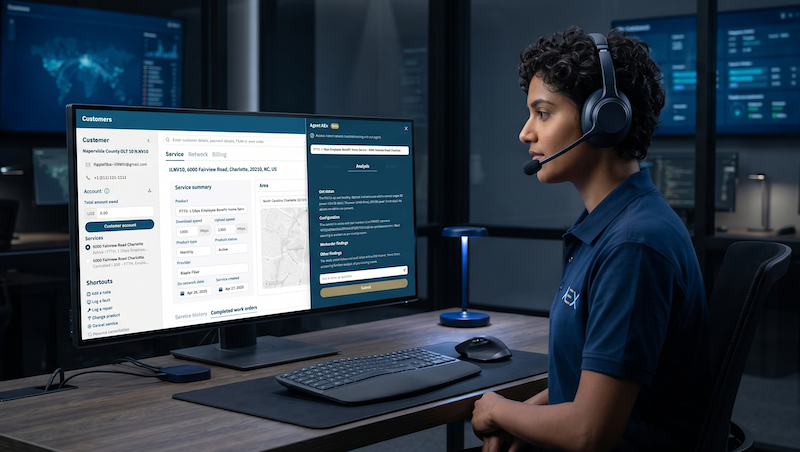
Think about what a support agent needs to fully resolve a typical interaction. They need the account overview: who the customer is, what they owe, and which services are active. They need service history: what has changed, what work orders are open, what was done last. They need network visibility: is the device online, what does the connection look like, can they reboot or reprovision remotely. And they need billing access: can they apply a credit, update a payment method, process an upgrade.
Four distinct areas of customer data. In most operator environments, those four areas live in four different systems. That gap between information and action is where handle times grow, first-call resolution suffers, and upsell moments disappear.
Understanding where that gap sits in your broader operational stack matters too. The billing and support layer is the commercial side of what OSS/BSS platforms are designed to unify -- if you want to understand how the operational and business systems connect across the full order-to-cash flow, it helps to see how provisioning, activation, and billing fit together before you focus on the support layer specifically.
Speed comes from having the full picture
Your support and retention teams move at the speed of their tools. When account details, services, network status, and billing are all in a single operational view, agents can act instantly without transfers, tab-switching, or context loss.
That means a billing dispute with an underlying network issue is resolved in a single interaction, not escalated across two teams. A retention call becomes an upsell opportunity because the agent can see what the subscriber is on, what they are eligible for, and action it right there. And a routine support call ends with a customer who feels looked after, not passed around.
The audit trail that comes with a unified view matters too. Every action logged, every change recorded -- not just for compliance, but because it means the next agent picking up that account already knows the full story.
What changes when your team can see everything
Consider a support team at a regional fiber operator. Before a unified customer view, handling a billing dispute with an underlying network issue meant three minutes pulling up information across systems, another few confirming the service problem, then escalating because the agent could not take action from where they were sitting. Average handle time: over twelve minutes. First-call resolution: inconsistent.
With a single operational view, the same interaction looks different. The agent can see the account, the open service issue, and the device status on a single screen. They reboot the device, apply a courtesy credit, and offer an upgrade before the customer has had time to get frustrated. Handle time drops. Transfers drop. A routine call becomes a retention moment.
Multiply that across a team, across hundreds of interactions a week, and the impact on churn and revenue becomes significant fast. The features and benefits of the AEX Inc platform are designed around exactly this kind of operational reality -- where every customer touchpoint from activation through billing lives in a connected system rather than a collection of separate tools.
The growth connection
Retention and growth are often treated as separate problems. Retention is what you do when something goes wrong. Growth is what happens when things are going well. In practice, they are the same conversation.
A support team with a complete customer view not only resolves issues faster. They identify upgrade opportunities in context, catch churn signals early, and engage subscribers with confidence rather than scrambling for information. That is not just better service; it is a growth motion built into every customer interaction.
For fiber operators scaling their subscriber base, this also connects directly to how your field operations feed the support layer. When field completion data automatically triggers provisioning and starts the billing clock, the support team inherits an accurate record from day one. There are no gaps between what happened in the field and what the agent sees on screen.
Want to see what a unified customer view looks like in practice? Take a look at AEX customer management features.
Request a demo today.