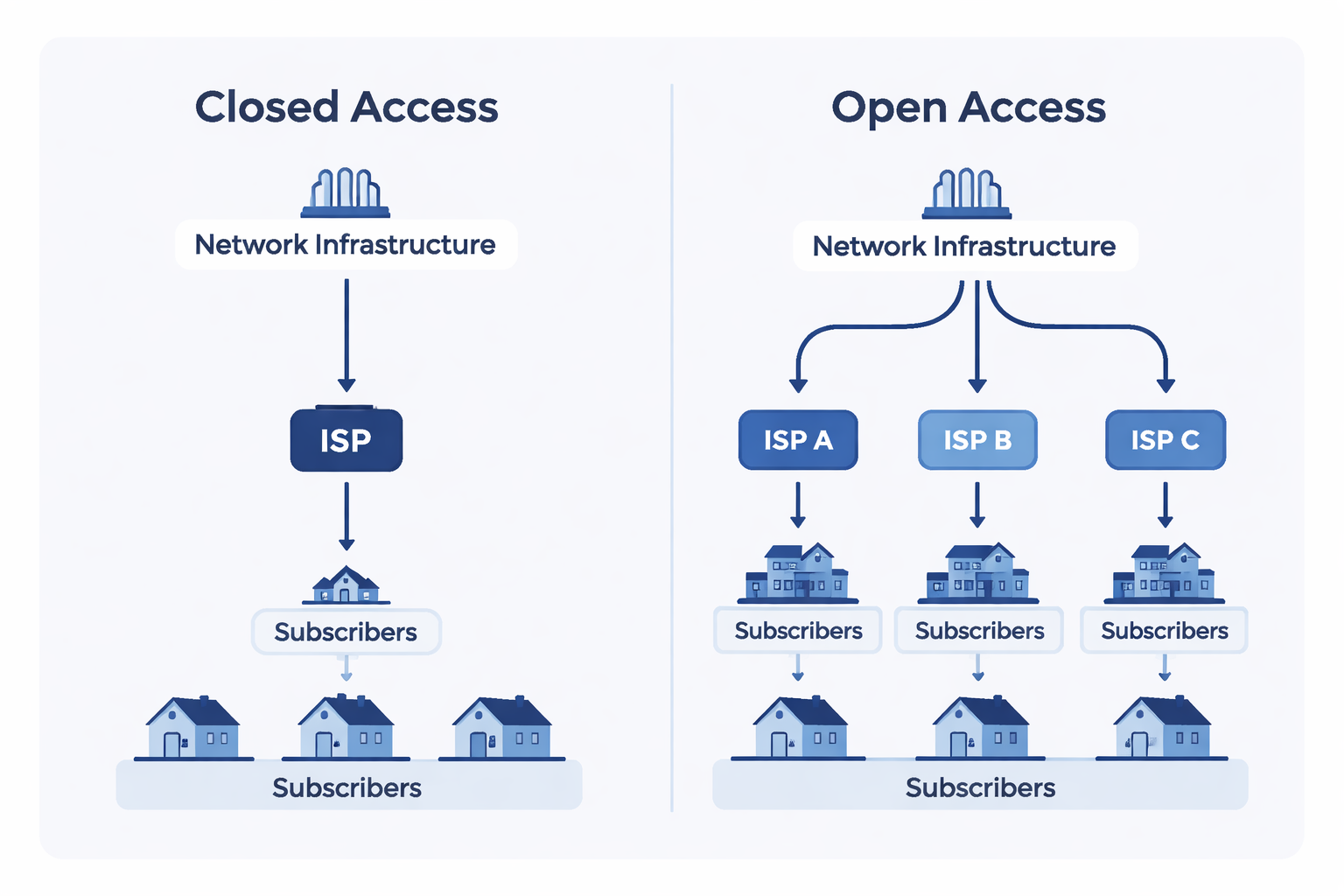
Open access and closed access are two ways to run a fiber network. In a closed access network, one company owns the fiber and sells internet service to every subscriber on it. In an open access network, the network owner leases access to several retail ISPs, and each subscriber picks their provider. That one choice shapes everything downstream, from provisioning and billing to which software can actually run the business.
What Is the Difference Between Open Access and Closed Access?
The difference comes down to one question: who controls the relationship between the physical network and the subscriber?
In a closed access model, the same operator who builds and maintains the fiber infrastructure also sells and manages service to end subscribers. The network and the retail business are vertically integrated. The operator controls pricing, packages, customer experience, and everything in between.
In an open access model, those two layers are separated by design. One entity, often called the network operator or open access provider, builds and maintains the physical fiber plant. Multiple retail ISPs, sometimes called retail service providers or RSPs, lease access to that infrastructure and compete to sell services to end subscribers over the same network. The subscriber chooses their provider. The infrastructure provider serves them all.
Both models are active in the US market. Understanding the operational and commercial differences between them matters for any operator making platform and infrastructure decisions, because the two models place very different demands on the software systems that run them.
Open Access vs Closed Access at a Glance
| Closed access | Open access | |
|---|---|---|
| Who owns the subscriber | The network operator | The retail ISP the subscriber chooses |
| How the network owner earns | Retail subscriptions | Wholesale access fees from each ISP |
| ISPs on the network | One | Several, competing on the same fiber |
| Provisioning | One service profile per subscriber | A separate profile, VLAN and parameters for each ISP |
| Billing | Operator bills subscribers directly | Wholesale invoicing to each ISP, sometimes plus billing subscribers on an ISP's behalf |
| Product catalog | One catalog, owned by the operator | Each ISP runs its own catalog and pricing |
| Fault handling | One team, end to end | Crosses company lines between ISP and network owner |
| Where it's common in the US | Most commercial fiber operators | Municipal networks and state or local programs |
How Does a Closed Access Network Work?
Closed access is the traditional model for most US fiber operators, from large incumbents to greenfield ISPs entering new markets.
The operator controls the full stack. They own the fiber, manage the ONTs, configure the provisioning, set the product catalog, handle billing, and own the customer relationship from acquisition through retention. All revenue flows directly to the operator. All costs, including build, maintenance, and customer support, sit with the operator as well.
From an operational standpoint, closed access is simpler to manage because there is only one set of service parameters, one billing relationship, and one provisioning workflow per subscriber. Every system, from the OSS through to the BSS, serves a single retail identity.
The commercial trade-off is that the operator bears the full cost of building and maintaining infrastructure with no contribution from competing providers. In lower-density markets, that cost structure can make the business case for a fiber build harder to justify without outside funding such as grants or municipal support.
How Does an Open Access Network Work?
Open access networks shift the economics by spreading the commercial layer across multiple service providers.
The infrastructure operator builds the network and leases wholesale access to retail ISPs, who then market and sell services to end subscribers. The infrastructure operator earns revenue through wholesale access fees rather than retail subscriptions. The ISPs compete on price, service, and customer experience while sharing the underlying infrastructure.
From a subscriber's point of view, open access looks like choice. Multiple ISPs appear on a coverage checker or sign-up portal, the subscriber picks one, and the infrastructure operator provisions the service to the specification that ISP requires.
From an operational standpoint, open access is a lot more complex. The provisioning system has to manage service profiles for multiple ISPs over the same physical ONT infrastructure. Each ISP may have different bandwidth tiers, VLAN configurations, authentication parameters, and billing relationships. The infrastructure operator needs to keep each ISP's configuration separate while running them all over shared hardware.
Open access is most common in municipal fiber networks and in markets where public funding or local policy encourages infrastructure sharing. It is more established in Europe and parts of Asia than in the US, but US examples are growing. UTOPIA Fiber, one of the best-known open access networks in the country, partners with 19 private-sector ISPs over the same Utah network.
How Does Open Access Change What Your Platform Has to Do?
The choice between open and closed access shapes what a fiber operator platform needs to do in several specific ways.
Provisioning. In a closed access environment, the provisioning system manages one service identity per subscriber. In an open access environment, it has to handle ISP-specific service profiles, VLAN tagging by provider, and authentication parameters that may differ across providers, all running over the same physical infrastructure. A platform that can't keep ISP configurations cleanly separated creates service errors that affect multiple providers at once. That provisioning complexity is one reason zero-touch provisioning systems need to be built around hardware-agnostic, multi-profile activation rather than single-operator workflows.
Billing. Closed access billing is a direct relationship between the operator and the subscriber. Open access billing involves wholesale invoicing to each ISP, and those ISPs may run on different billing cycles and rate structures than retail subscribers. Some infrastructure operators also bill end subscribers on behalf of their ISPs, which adds another layer. The billing platform needs to handle both wholesale and retail models without needing separate systems.
Product catalog. In a closed access model, the operator controls the product catalog entirely. In an open access model, the infrastructure operator may present a neutral availability layer while each ISP keeps its own product catalog and pricing. The platform needs to support that separation instead of assuming a single catalog owner.
Customer support. When a subscriber on an open access network reports a fault, the support workflow crosses company lines. The ISP owns the customer relationship, but the infrastructure operator may need to diagnose and fix physical network issues. Clear interfaces between ISP support teams and the infrastructure operator's NOC are a practical requirement, not an optional integration.
What Is a Hybrid Open Access Model?
Not every operator fits neatly into one category.
Some operators run closed access networks today but are building in markets where a municipal partner or local funding program expects open access. Others act as both the infrastructure provider and a retail ISP, competing with other ISPs on their own network while collecting wholesale fees from them.
These hybrid models are the most demanding to run because the fiber operator platform has to support both access models at the same time, including separate provisioning workflows, billing models, and customer data structures, without creating conflicts between the retail and wholesale sides of the business.
A platform built around a single access model creates workarounds and manual processes when the operator's business model doesn't fit that assumption. Vendors that support both open and closed access natively from the same system give operators room to change their commercial structure without replacing their operational infrastructure.
One distinction is worth keeping straight. A network that wholesales capacity to a single retail partner is a wholesale arrangement, not open access in the multi-provider sense. The platform demands are different too. Open access means several ISPs ordering, provisioning, and billing over the same footprint at the same time.
Where Is US Open Access Heading?
The US industry has started working on the operational side of open access in public. In February 2026, ATIS launched the Open Access Network Forum, with Scott Baker of AT&T as chair. Its goal is a single Open Access Implementation Specification covering business, operational, technical, and regulatory considerations, so that bringing on a new service provider stops meaning a custom integration every time.
That focus says a lot about where open access actually gets hard. Building shared fiber is well understood. Onboarding ISPs, exchanging order and service data, provisioning per-ISP services, and settling money between the network owner and each ISP are where operators spend their time. Those are platform questions, which is why the choice of OSS/BSS matters more on an open access network than on a closed one.
How Does Funding Affect Open Access in the US?
In the US, open access shows up in funding mostly at the state and municipal level, not through BEAD.
BEAD does not require open access. The original BEAD rules included an interconnection and wholesale access section, largely tied to middle-mile infrastructure. NTIA removed that section in its June 6, 2025 BEAD Restructuring Policy Notice, and BEAD has never required retail open access. If you're working through what a BEAD award does require on the operations side, getting a BEAD-funded build operationally ready covers that ground.
State and local programs are a different story. New York's ConnectALL office made up to $36 million available in January 2026 through its Municipal Infrastructure Program, specifically for open-access and publicly controlled broadband infrastructure. Municipal networks that own the fiber and lease it to private ISPs, like UTOPIA, are another common route.
That creates a practical planning question. If you partner with a municipal network owner, pursue state or local funding, or just want the option to wholesale later, a platform that only handles closed access provisioning and billing can force a costly systems change partway through. Building on a platform that handles both models from the start keeps that option open.
Frequently Asked Questions
What is the main difference between open access and closed access fiber?
In a closed access network, the same operator builds the infrastructure and sells service directly to subscribers. In an open access network, the infrastructure and the retail service layer are separated, so multiple ISPs can offer competing services over the same physical network.
Is open access fiber common in the United States?
Open access is less common in the US than in Europe, but it is growing. It appears most often in municipal fiber networks and in state or local programs that favor shared infrastructure. Most US commercial fiber operators still run closed access networks.
Does BEAD require open access?
No. BEAD has never required retail open access, and NTIA removed the original interconnection and wholesale access section in its June 2025 restructuring notice. Where public money does favor open access, it is usually at the state or municipal level.
Can a fiber operator run both open and closed access on the same network?
Yes, though it requires a platform that supports both models natively. Some operators run a hybrid model where they act as both the infrastructure provider and a competing retail ISP, collecting wholesale fees from other ISPs while also selling directly to subscribers. This takes clear separation between the wholesale and retail functions at the platform level.
How does open access affect fiber provisioning?
Open access provisioning requires the platform to manage separate service profiles, VLAN configurations, and authentication parameters for each ISP on the network, all running over shared physical infrastructure. Each subscriber's configuration has to match their chosen ISP's parameters while using the same ONT hardware as subscribers on other ISPs.
What is a retail ISP or retail service provider (RSP)?
A retail ISP, also called a retail service provider or RSP, is a company that leases wholesale access to an open access fiber network and sells internet or other services directly to end subscribers. The ISP handles the customer relationship, pricing, and service packages while the infrastructure operator maintains the physical network and the underlying provisioning.
Does open access fiber affect billing?
Yes, significantly. Open access adds wholesale billing between the infrastructure operator and each ISP, which runs separately from whatever billing the ISP has with its own subscribers. The infrastructure operator's platform needs to handle wholesale invoicing across multiple ISPs on different rate structures and billing cycles, in addition to or instead of direct subscriber billing.