
Launching a fiber network gets the headlines, but as a product manager who has been on the front lines of network operations, I can tell you that scaling an active, live operation is where the real engineering happens. You are no longer building on an empty coverage map. You are changing the systems that run a live network, bill real customers, and deploy field crews every single day.
When you hit a growth ceiling, the seams in your operation are violently exposed. Installs start slipping because dispatch is still running on spreadsheets and whiteboards. Revenue leaks because provisioning and billing are disconnected steps that rely on a human remembering to reconcile them at the end of the month. Your legacy systems got you to this point, but they are not going to get you to your next major subscriber milestone.
The Rip-and-Replace Fallacy
The immediate instinct for many operators is to tear everything out. The industry has sold a myth that the only way to modernize an aging OSS/BSS stack is a wholesale rip-and-replace. But a forced, big-bang cutover introduces massive, unacceptable risk. Every workflow your team already knows has to be relearned simultaneously. Any gap between your legacy system and the new platform shows up directly in front of your subscribers, who frankly do not care what software you run, only that their internet works and their bill is accurate. A massive cutover is not a modernization strategy; it is a risk you are choosing to absorb all at once.
We built AEX because we were operators who needed a system to run our own national rollout and could not buy it. We learned that the real constraint in scaling a network is not a lack of software features, but the manual handoffs between different software vendors. Most operators assemble their stack from separate tools for planning, equipment, field work, provisioning, billing, and support. Then, they pay a permanent integration tax to keep those systems talking. As we've detailed before, this OSS and BSS separation creates invisible risk across your operation.
Targeting the Seams in Your Operation
To scale safely, you have to eliminate those handoffs. We look at the entire lifecycle of a network across how AEX works in 6 stages: Plan, Build, Sell, Install, Activate, and Run. AEX is the only partner that covers a fiber network end-to-end, including the network services it runs on, the software that runs the business, and the field execution that connects subscribers. One company, one platform, no seams between them.
Instead of a multi-year replatforming project, modernization must be a series of managed transitions. Because AEX is modular and API-open by design, you start by targeting the workflow causing the most operational pain today. You keep the CRM or accounting tools your team likes, and you integrate the rest.
Closing the Install-to-Invoice Gap:
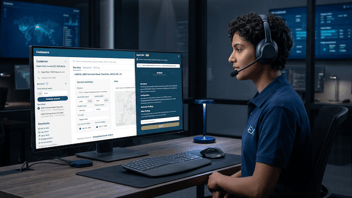
If a completed installation does not reliably and immediately trigger accurate billing, you are bleeding revenue. With AEX Software and AEX Field Service, a closed order schedules the field work automatically. When that technician completes the job, the closure immediately triggers zero-touch provisioning. Connectivity is verified before the technician leaves. That activation then triggers the first invoice on the exact same day. No manual provisioning queues, and no month-end reconciliation nightmares. Our operators routinely report a 60%+ faster time to invoice simply by letting one completed step trigger the next.
Unlocking Technician Throughput:
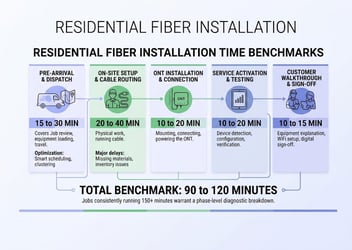
Smart scheduling accounts for route, technician location, and skill set, pushing work to an offline-first mobile app that keeps crews productive even in dead zones. AEX customers sustain 3 to 5 installs per technician per day, representing a 2-3x improvement in throughput.
Preserving Hardware Independence:
Another massive roadblock to scaling, especially when integrating acquisitions, is hardware lock-in. You should not have to standardize your legacy hardware before a modernization project pays for itself. AEX is multi-vendor to its foundation, supporting ten OEM ecosystems (including Nokia, Calix, Huawei, and Ubiquiti) plus any TR-069 device. You can provision across mixed hardware in real time, layer 2 and layer 3, with automatic rollback.
A Commercial Model Aligned With Growth
Ultimately, your operational software should align with your financial reality. A fiber build is a massive fixed investment against revenue that ramps over years. A platform priced on flat licenses or rigid site tiers fights that curve. Instead, AEX has a predictable pricing model set per active subscriber. Your platform cost tracks your subscriber base rather than running ahead of it. You pay for scale only when you actually have it.
Modernizing a live network is about discipline. As outlined in our guide to zero-touch OSS/BSS migration, you sync data incrementally, you sequence your upgrades around your most expensive handoff points, and you demand a coexistence period where old and new systems run in parallel. The operators who win aren't the ones who survived a chaotic weekend cutover; they are the ones whose subscribers never even noticed the transition happened.
Ready to see how the loop closes on your own network? Schedule a Demo with our team.
Frequently Asked Questions
Do we need to replace our entire OSS/BSS system at once? No. Incremental modernization allows you to sync data from existing systems and build connected workflows in stages. AEX is modular by design, meaning you can adopt specific solutions like field service or billing while retaining your legacy CRM, avoiding the disruption of a big-bang cutover.
Where should modernization of a live network start? Start where the pain is loudest, which is usually the gap between field execution and billing. Fixing the install-to-invoice gap ensures that every completed field job immediately triggers zero-touch provisioning and same-day billing, plugging your most significant revenue leaks first.
How does AEX handle legacy hardware or acquired networks? You should not have to replace your hardware to upgrade your software. AEX supports ten OEM ecosystems (including Nokia, Calix, and ZTE) and any TR-069 device. This allows you to integrate acquisitions and normalize workflows without forcing a hardware standardization project first.