Truck rolls are the most expensive thing a fiber operator does, and most operators don't actually know what theirs cost. I've seen finance teams quote a truck roll at $75 because they're only counting technician labor, and others quote $400 because they're loading in corporate overhead that shouldn't sit on field operations.
Deloitte's telecommunications workforce research consistently shows that operators who allocate costs consistently are the ones making the best capacity and staffing decisions. The real number for most operators lives somewhere between those two extremes, and getting clarity on where yours falls is the starting point for almost every operational improvement conversation worth having.
What's Included in a Fully Loaded Truck Roll Cost
A fully loaded truck roll cost includes technician labor for the full job plus travel time, vehicle cost (lease, fuel, maintenance, insurance), tools and equipment amortization, parts carried on the truck that are consumed during the visit, dispatch and back office allocation, and any repeat visits triggered by the original job.
It does not include corporate overhead, sales and marketing costs, or network infrastructure depreciation. Those belong elsewhere in your P&L. When I talk about truck roll cost in this piece, I'm talking about fully loaded direct cost. That's the number that matters for operational decisions.
The Benchmark Range
Across the fiber operators I've worked with, truck roll costs fall into three bands:
Low band ($125 to $175 per roll): These operators run modern field service platforms with optimized routing, real-time parts visibility, and mobile workflows that work offline. They hit 90 percent or higher first-visit completion and their technicians sustain 3 to 5 installs per technician per day, a 2-3x improvement over legacy setups, which aligns with the productivity benchmarks the Fiber Broadband Association publishes for well-run fiber operations.
Mid band ($175 to $250 per roll): This is where most operators actually live. They have some automation in place, but handoffs between CSR, dispatch, and field still involve manual steps. First-visit completion sits around 80 to 85 percent, and technicians struggle to exceed 3 to 4 completed jobs per day.
High band ($250 to $350 per roll): These operators are still running on dispatch spreadsheets, phone calls to technicians, and paper work orders. First-visit completion is often below 75 percent. Technicians are lucky to complete three jobs per day because so much time is lost to drive time, parts runs, and waiting on information.
Rural operators generally run 15 to 25 percent higher across all bands because drive time is longer and density is lower. NTCA's rural broadband industry data consistently track this variance across member operators. It's a real variable, not a failure mode.
The Repeat Visit Problem
Here's the number that actually matters, though. It's not the cost per roll. It's the cost per completed subscriber install.
If your truck roll cost is $200 and your first-visit completion rate is 75 percent, your effective cost per completed install is roughly $267, because one in four installs requires a second visit. If your first-visit completion rate is 90 percent, that same $200 truck roll produces a $222 effective cost per install.
A 15-point improvement in first-visit completion rate saves you $45 per install. Multiply that by your annual install volume, and the number gets large fast. For a mid-sized fiber operator doing 10,000 installs a year, that's $450,000 in avoided cost per year. This is why field service optimization is one of the few operational levers that pays for itself inside a single fiscal year. I've written more about where that capacity actually comes from in field service optimization and technician capacity.
The Biggest Cost Drivers
In order of impact on your truck roll cost, here's what moves the number most:
First-visit completion rate: This is the single biggest lever, and I've gone deeper into how to actually improve it in how to increase first-time fix rates in field service.
Parts inventory accuracy: Trucks that arrive at a job without the right ONT, drop cable, or mounting hardware either fail the install or waste an hour driving to a warehouse. Real-time parts tracking tied to job dispatch is worth more than most operators realize.
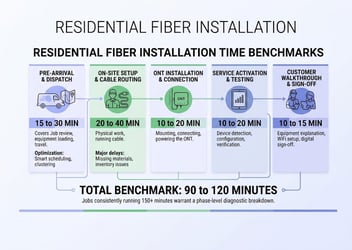
Scheduling and routing efficiency: Every hour a technician spends in the truck is an hour they're not billing. Modern routing should keep drive time under 25 percent of the working day. Dispatch-by-spreadsheet typically runs 40 percent or higher. Time on site matters just as much, as detailed in my fiber installation time benchmarks piece.
Skill matching: Sending a technician to a job they can't complete because they don't have the certification is one of the most expensive errors in the field.
Appointment adherence: No-shows and customer reschedules kill utilization. Operators who shift to customer self-scheduling with automated reminders typically see no-show rates drop by a third or more.
What Actually Reduces Truck Roll Cost
Closing the gaps between disconnected systems. When the field is separated from the back office, handoffs break down. Here is what fixes it:
Eliminating the Handoff Gap: The single most effective way to reduce costs is to ensure that closing the job triggers zero-touch provisioning and same-day billing with no manual handoffs in the middle. Every step triggers the next automatically.
Unified Dispatch: Real-time visibility into technician location, parts inventory, and job status closes the gap between what dispatch thinks is happening and what's actually happening.
Offline Mobile Execution: Fiber installs happen in basements and rural areas. A native app built on an offline sync-and-merge engine ensures a job doesn't stop just because the signal drops.
Customer Self-Scheduling: Letting the subscriber pick their own slot, change their address, or upgrade their package at the point of booking without calling anyone.
How to Calculate Your Own Number
If you want to calculate your own truck roll cost, you need six inputs:
-
Annual technician labor cost including benefits, divided by the number of completed jobs per year.
-
Annual vehicle cost (lease, fuel, maintenance, insurance), divided by completed jobs per year.
-
Average parts consumption per completed install.
-
Dispatch and back office cost allocated to field operations, divided by completed jobs per year.
-
Tool and equipment amortization, divided by completed jobs per year.
-
Your first-visit completion rate. This is what converts your raw truck roll cost into an effective cost per completed install.
Add the first five and divide by your first-visit completion rate to get your real number. Most operators who run this calculation for the first time find their cost is higher than they thought.
What Good Looks Like
A well-run fiber operator on a modern platform hits these marks:
| Metric | Benchmark |
| First-visit completion rate | 90% or higher |
| Average completed jobs | 3 to 5 installs per technician per day (a 2-3x improvement over industry laggards) |
| Drive time | Under 25% of the working day |
| Parts-related failed visits | Under 3% |
| Customer no-show rate | Under 10% |
| Effective truck roll cost per completed install | $150 to $200 |
If your numbers are significantly off these benchmarks, the cost of closing the gap is almost always lower than the cost of staying where you are. I covered the underlying mechanics in how to remove field service bottlenecks in fiber provider operations.
Closing
Truck roll cost is the operational metric that tells you more about how your business is actually running than any other single number. Most operators underestimate theirs. The ones who measure it honestly and work the levers I've outlined here are the ones pulling ahead. Operators like Ripple Fiber have made material progress on these metrics, doubling year on year in both passings and customers by running their entire operation on an integrated platform.
Frequently Asked Questions
What is the average truck roll cost for a fiber operator? The average fully loaded truck roll cost for a fiber operator ranges from $150 to $300 per roll. Operators with modern field service platforms sit at the lower end. Operators still running manual dispatch sit at the higher end. Rural operators run 15 to 25 percent higher across all bands due to drive time.
How do I reduce truck roll costs? The highest-impact levers are improving first-visit completion rate, tightening parts inventory accuracy, optimizing routing and scheduling, and introducing customer self-scheduling. The core solution is removing the handoffs between teams and systems.
What's a good first-visit completion rate for fiber installs? 90 percent or higher is the benchmark for operators running modern field service platforms. Most operators sit in the 75 to 85 percent range. Every 5-point improvement meaningfully reduces your effective cost per completed install.
Why is effective truck roll cost different from truck roll cost? Truck roll cost measures what each dispatched visit costs you. Effective truck roll cost measures what each completed subscriber install costs you, accounting for repeat visits. The gap between the two is a direct function of your first-visit completion rate and it's usually where the real money is hiding.
What technology reduces truck roll costs most? Platforms that run the network infrastructure, the software, and the field execution as one continuous loop. For example, AEX Field Service natively connects scheduling and dispatch directly to AEX Software. This means when a technician closes an order, it automatically triggers zero-touch provisioning and same-day billing, eliminating the manual provisioning queues and billing reconciliation gaps that drive up costs. Point solutions addressing one piece rarely move the overall number because truck roll cost is driven by handoffs between systems, not by any single system.