
Greenfield fiber builds get most of the attention because they're the exciting part, new territory, new subscribers, a clean slate. Brownfield modernization doesn't get the same attention, and it's often the harder problem. You're not building on empty ground. You're changing the systems running a network that's already live, already billing customers, and already has crews in the field every day.
That constraint changes everything about how modernization has to happen.
Why rip-and-replace is the wrong instinct
The obvious approach to modernizing an aging OSS/BSS stack is to replace it wholesale, migrate everything to the new system, and cut over on a set date. It's also usually the wrong approach. A full replacement means every workflow your team already knows has to be relearned at once, every piece of legacy data has to be migrated before go-live, and any gap between the old system and the new one shows up directly to customers who don't care which system is running behind the scenes.
Operators who've been through a forced big-bang cutover tend to describe it the same way: months of preparation, a chaotic go-live week, and a long tail of cleanup afterward. That's not a modernization plan. That's a risk you're choosing to take on all at once instead of managing in pieces.
What incremental modernization actually looks like
The alternative is modernizing in stages, syncing data from existing systems into the new platform and building connected workflows around what's already running, rather than requiring everything to be replaced before any of it delivers value. You don't need to migrate every historical record before you can start realizing benefits from better provisioning, tighter field execution, or unified billing.
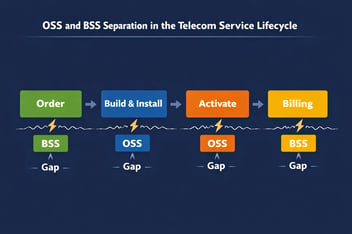
This works because most of the risk in brownfield modernization sits at specific handoff points, not everywhere at once. The same logic that applies to unified OSS/BSS generally applies here: the highest-risk moments are transitions, order to build, build to activation, activation to billing, and those transitions are exactly where a phased approach can start proving value before the rest of the migration is complete. Why OSS and BSS Separation Creates Invisible Risk covers why these handoff points matter so much as networks scale, and the same handoffs are where brownfield modernization should focus first.
Sequencing the modernization
Start with the workflow causing the most operational pain today, not the one that's technically easiest to migrate. For most brownfield operators, that's the connection between field execution and billing. If completed work in the field isn't reliably triggering accurate, timely billing, that's revenue leaking every day the old system stays in place, and it's usually the highest-value place to start.
From there, sequencing depends on what's actually running today. An operator with a reasonably solid billing system but a disconnected field service tool has a different priority order than one running spreadsheets for dispatch. The point isn't a universal sequence, it's identifying your specific highest-risk handoff and modernizing that first, proving the approach works, and expanding from there.
Running old and new systems in parallel
A modernization plan that can't tolerate a period of coexistence between old and new systems is a plan built around convenience for the vendor, not stability for your operation. Legacy data needs to sync into the new platform incrementally, and both systems need to be able to run without one blocking the other during the transition.
This is also where a lot of migration promises fall apart in practice. A vendor who tells you coexistence isn't necessary because their cutover is fast is usually underselling the complexity of your specific data and workflows. Zero-Touch OSS/BSS Migration for Broadband Operators covers what a realistic incremental migration path looks like, including how data syncs without forcing a single cutover moment.
What brownfield and greenfield have in common
Despite the different starting points, brownfield and greenfield modernization both depend on the same underlying principle: aligning provisioning, field execution, and billing around a shared source of truth for what's actually been delivered. Full Lifecycle Service Automation for Network Operators covers how that alignment works across both new builds and existing operations, and it's the same reason a platform capable of supporting greenfield, brownfield, and expansion programs from one system has an advantage over point solutions built for only one of those scenarios.
Operators expanding into new territory while also modernizing their existing footprint face this directly, since they're effectively running greenfield and brownfield programs simultaneously. A platform that treats these as separate problems requiring separate tools adds complexity exactly where you can least afford it.
Common mistakes in brownfield modernization
The most common mistake is underestimating data cleanup. Legacy address records, customer accounts, and network inventory accumulate inconsistencies over years, and migrating that data without a cleanup pass just moves the mess into a new system. The second most common mistake is modernizing billing before field operations are validated on the new platform, which creates a gap between what's being billed and what's actually happening in the field, the exact handoff risk brownfield modernization is supposed to reduce, not recreate. The third is treating the transition as purely a technical project, when the bigger risk is usually operational, teams working across two systems during the transition need clear ownership of which system is authoritative for which decisions.
Closing
Brownfield modernization succeeds when it's treated as a series of managed transitions rather than a single high-stakes event. Sync data incrementally, sequence changes around your actual highest-risk handoff points, and expect a coexistence period rather than trying to eliminate it. The operators who get this right aren't the ones who moved fastest. They're the ones who never had to explain to a customer why their bill or their service was wrong during the transition.
FAQ
What does brownfield modernization mean for a fiber network?
It means upgrading or replacing the OSS/BSS systems running an existing, live fiber network, as opposed to a greenfield build where there's no legacy system or existing customer base to account for. The network stays operational and billing continues throughout the transition.
Do I need to replace my entire OSS/BSS system at once during brownfield modernization?
No. Incremental modernization, syncing data from existing systems and building connected workflows in stages, avoids the disruption and risk of a single big-bang cutover, and lets you start realizing benefits before the full migration is complete.
Where should brownfield modernization start?
Start with the workflow causing the most operational pain today, most commonly the handoff between field execution and billing, rather than whichever piece is technically easiest to migrate first. Identifying your highest-risk handoff point and modernizing that first proves the approach before expanding it.
Can old and new systems run at the same time during a brownfield transition?
Yes, and they generally should. A modernization plan that requires eliminating the legacy system on day one is higher risk than one that supports a coexistence period while data syncs incrementally and workflows are validated on the new platform.
What's the biggest risk in brownfield fiber modernization?
Underestimating data cleanup and modernizing systems out of sequence, particularly updating billing before field operations are validated. Both create the same handoff gaps that modernization is meant to eliminate, just under a new system instead of the old one.