You manage field crews across a utility footprint that now includes fiber, broadband, or network services. Every day, dispatchers juggle installation schedules, maintenance tickets, and service activations across systems that were never designed to talk to each other. When a customer calls in about a delayed install, your team pulls up one screen for the work order, another for network status, and a third for billing context. By the time they piece the full picture together, the customer has been waiting.
This is what happens when field service management software is built for a single vertical. Utility FSM platforms handle metering and outage response. Telecom FSM platforms handle provisioning and truck rolls. But for operators running both—municipal utilities with fiber-to-the-home, broadband providers with energy operations, or converged infrastructure companies—neither toolset fits the whole workflow.
This guide walks through the evaluation criteria that matter when your operations span both utility company work and telecom field services. AEX Inc connects field execution to OSS/BSS workflows for operators managing these hybrid environments, and the goal here is to help you identify what any FSM platform needs to deliver when your crews work across network and infrastructure boundaries.
Key Takeaways: Choosing FSM Software for Utility and Telecom Ops
- Field service management software for mixed utility-telecom operations must connect execution data to provisioning and billing without manual reconciliation.
- Scheduling intelligence needs to account for cross-trained crews, skill-based routing, and jobs that span utility and network workflows.
- AEX Inc gives you lifecycle automation from serviceable address to billing, connecting field execution directly to OSS/BSS systems.
- Execution data continuity eliminates the information gaps that cause billing disputes, delayed activations, and repeat truck rolls.
- Your FSM platform should treat field completion as a trigger for downstream automation, not a dead end requiring manual handoffs.
What Is Field Service Management Software?
Field service management software coordinates the people, vehicles, and work orders that move through your service territory every day. At its core, an FSM platform handles scheduling, dispatch, mobile workforce communication, and job documentation.
For utility and telecom operators, FSM goes beyond basic scheduling. You need systems that track installations, faults, repairs, and preventive maintenance across infrastructure that includes power lines, fiber networks, customer premises equipment, and everything in between.
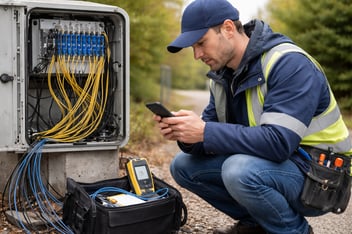
The operational reality is that technicians often work across service types. A crew installing fiber drops might also handle smart meter work. A technician responding to an outage might need to verify network equipment status on the same visit. FSM software that only sees one side of your operation forces your teams into workarounds.
Why Utility and Telecom Operations Need a Unified Approach
Utility companies have added broadband services. Telecom providers have acquired energy assets. Municipal operators now run fiber-to-the-home alongside water, electric, and gas services. This convergence creates an operational challenge that most FSM platforms were never designed to address.
The Fragmentation Problem
When your utility operations run on one platform and your telecom operations run on another, every cross-functional job creates friction. A single customer interaction might require three systems: one for the utility work order, one for network provisioning, and one for billing across both services.
This fragmentation shows up in measurable ways. Handle times increase as dispatchers switch between applications. Errors compound when data must be entered manually into multiple systems. Billing disputes arise when field completion in one system does not trigger updates in another.
What Cross-Industry Operators Actually Need
If you manage mixed utility and telecom field services, your FSM platform needs to handle workflows that span both domains. That means scheduling systems that understand skill requirements across service types, dispatch logic that optimizes routes for multi-service appointments, and execution data that flows into the right downstream systems regardless of which crew completed the work.
The operators scaling successfully in this environment have stopped treating FSM as a standalone dispatch tool. They treat it as the operational layer that connects field execution to everything else—provisioning, activation, billing, customer communication.
Core Evaluation Criteria for Field Service Management Software
When you evaluate FSM platforms for hybrid utility-telecom operations, the standard feature checklist falls short. Mobile apps and scheduling calendars are table stakes. The differentiators live in how the platform handles cross-domain complexity, data continuity, and downstream automation.
Scheduling Intelligence Across Service Types
Your technicians carry multiple certifications. Some are trained for fiber splicing and ONT installation. Others handle meter work and electrical inspections. Many do both. Your FSM scheduling engine needs to account for this.
Skills-based dispatch means assigning the right technician based on what the job actually requires—not just who happens to be available. When your crews work across utility and telecom, the scheduling system must understand that a fiber install and a smart grid meter replacement require different skill sets, even if the same technician can do both.
Route optimization adds another layer. When a dispatcher builds a day's schedule, the system should factor in travel time, appointment windows, equipment requirements, and the sequence that minimizes windshield time while maximizing completed jobs. AEX Inc delivers optimized routing and skills-based dispatch that accounts for these cross-service realities.
Execution Data Continuity
This is where most FSM platforms fall short for hybrid operators. A technician completes a fiber installation. They capture photos, GPS coordinates, test results, and material usage in their mobile app. In a well-designed system, that completion data triggers automated updates downstream: the customer record reflects the new service, the network inventory updates, provisioning kicks off, and billing receives the activation signal.
In practice, many operators still run systems where field completion data sits in the FSM platform until someone manually reconciles it with other systems. This creates delays, billing disputes, and customer frustration.
Look for FSM platforms where execution data captured during field work in real time flows directly into OSS and BSS workflows. The field completion should be the trigger for downstream automation—not a data entry prompt for back-office staff. AEX Inc treats execution data as the operational system of record, connecting field completion to provisioning, billing, and customer communication automatically.
Mobile Workforce Capabilities
Field technicians need mobile tools that work in the conditions they actually encounter. That means offline capability when cellular coverage drops, intuitive interfaces that do not require training manuals, and workflows that guide technicians through required documentation without slowing them down.
For utility and telecom work, mobile apps should support job-specific requirements. A fiber splice job needs different documentation than a meter replacement. The mobile interface should adapt to the work type, prompting for the right photos, test results, and sign-offs based on what the technician is actually doing.
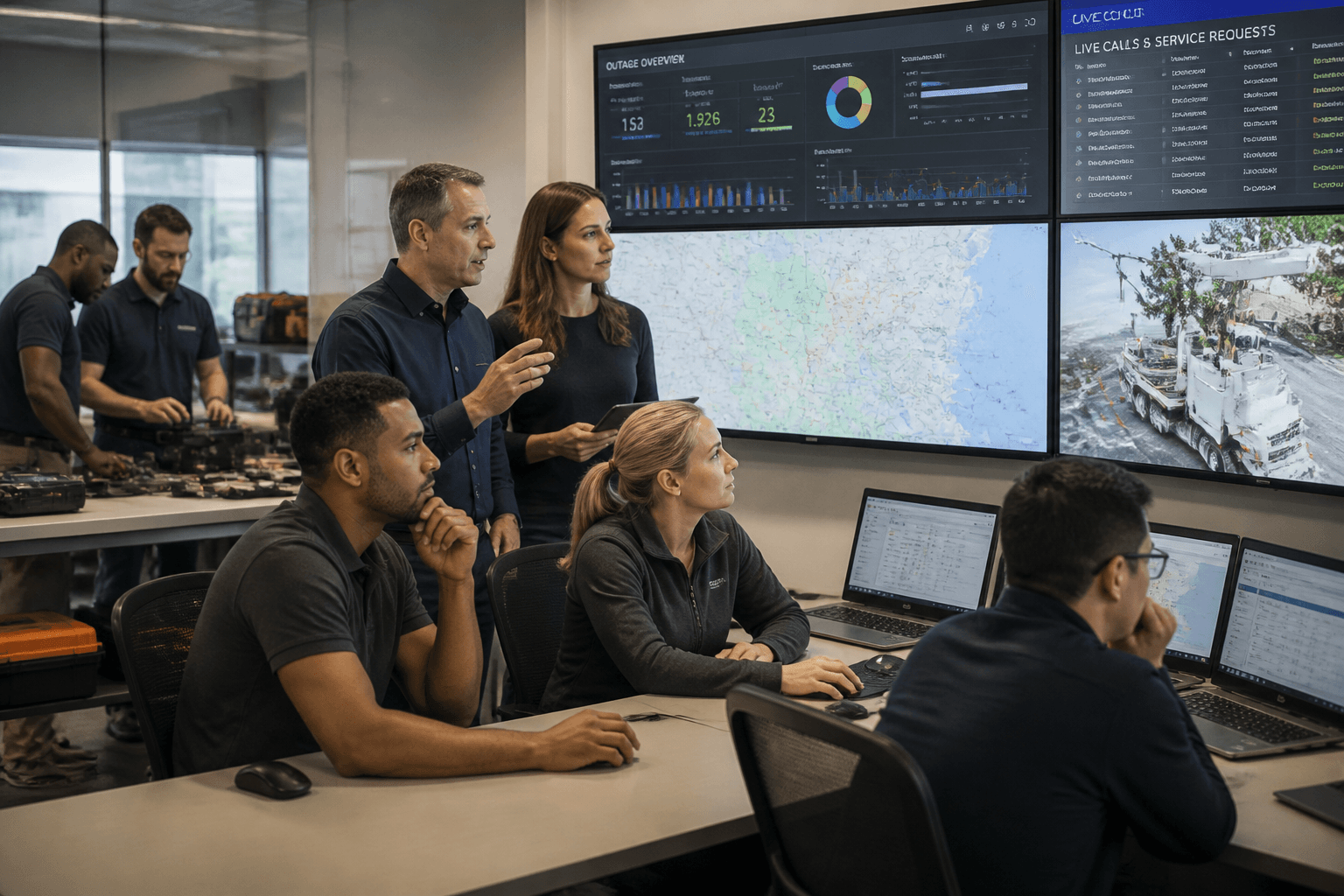
Your FSM platform should also enable real-time communication. Dispatchers need visibility into where crews are and what they are doing. Technicians need access to updated job details, customer information, and network status without calling the office.
Integration with OSS/BSS Systems
For telecom and broadband operations, your FSM platform cannot operate as an island. Work orders need context from network inventory. Completions need to trigger provisioning. Billing needs confirmation that services were actually activated.
Evaluate how the FSM platform integrates with your existing OSS/BSS stack—or whether it can replace that stack entirely. Some operators find that a unified platform that handles field service management alongside provisioning, activation, and billing eliminates the integration complexity altogether.
AEX Inc connects field execution to the full telecom service lifecycle, from coverage planning through service qualification, provisioning, activation, and billing. For operators evaluating FSM alongside broader OSS/BSS modernization, this unified approach eliminates the integration burden that fragments operations in multi-vendor environments.
How to Evaluate FSM Platforms for Mixed Utility-Telecom Operations
With core criteria defined, here is a practical evaluation framework. These questions help you differentiate between FSM platforms that check the feature box and platforms that actually address your cross-industry operational requirements.
Step 1: Map Your Cross-Domain Workflows
Before evaluating vendors, document the workflows that span both utility and telecom operations. Identify every point where data needs to move between systems—work order creation, dispatch, field completion, provisioning triggers, billing updates, customer notifications.
This mapping exercise reveals where your current fragmentation creates operational drag. It also gives you concrete scenarios to test during vendor evaluations.
Step 2: Define Your Skill Matrix
List the certifications and capabilities your technicians carry. Identify which skills apply to utility work, which apply to telecom work, and which technicians are cross-trained. Your FSM scheduling engine needs to accommodate this matrix.
Ask vendors how their platform handles multi-skill technicians and jobs that require combinations of skills. A fiber installer who also does electrical work should receive jobs that use both capabilities without requiring manual dispatcher intervention.
Step 3: Test Execution Data Flows
Request demos that show what happens after a technician marks a job complete. Follow the data. Does completion trigger provisioning? Does it update network inventory? Does it send a billing event? Does it notify the customer?
If any of these steps require manual intervention, ask why. Manual handoffs are where delays, errors, and revenue leakage accumulate.
Step 4: Evaluate Mobile Experience in Field Conditions
Have your technicians test the mobile app. Does it work offline? Can they complete required documentation without scrolling through irrelevant fields? Does it guide them through job-specific steps without unnecessary complexity?
Mobile usability directly impacts adoption. A powerful platform that technicians avoid using because the app is frustrating delivers no value.
Step 5: Assess Integration Complexity
If you plan to integrate the FSM platform with existing systems, evaluate the integration approach. Does the vendor offer pre-built connectors to your OSS/BSS platforms? What APIs are available? What is the typical implementation timeline for customers with similar integration requirements?
Alternatively, consider whether a unified platform that handles FSM alongside OSS/BSS functions reduces your total integration burden. Fewer integrations mean fewer failure points and faster time to value.
Scheduling and Dispatch for Cross-Industry Field Teams
Scheduling is where operational efficiency either multiplies or collapses. For operators managing utility and telecom work, the scheduling challenge is compounded by the diversity of job types, skill requirements, and customer expectations.
Moving Beyond Manual Dispatch
Manual scheduling creates bottlenecks. Dispatchers spend hours each day assigning jobs, balancing workloads, and adjusting for cancellations and emergencies. As your operation scales, this manual work does not scale with it—you either hire more dispatchers or accept declining efficiency.
Automated scheduling changes this dynamic. Based on job requirements, technician skills, location, and availability, the system assigns work and optimizes routes. Dispatchers shift from making every assignment to managing exceptions and handling escalations.
AEX Inc automates scheduling to assign jobs based on technician availability, skills, and proximity. This reduces dispatcher overhead while improving technician throughput. The system also handles real-time reoptimization when cancellations or emergencies change the day's plan.
Route Optimization in Multi-Service Territories
When your crews handle fiber installs, utility maintenance, and customer service appointments across the same territory, route optimization becomes critical. Every unnecessary mile driven is time lost and fuel spent. Over a fleet and a year, inefficient routing represents substantial cost.
Look for FSM platforms that optimize routes dynamically, factoring in traffic, appointment windows, and job priorities. The system should recalculate when conditions change—a morning cancellation should trigger route updates for the rest of the day.
Managing Appointment Windows and Customer Expectations
Customers expect accurate appointment windows. When a technician arrives outside the promised window, customer satisfaction drops and call center volume increases.
Your FSM platform should generate realistic ETAs based on actual route calculations and job durations. It should also support automated customer notifications that update when conditions change. If a technician is running late, the customer should know before they call to ask.
Execution Data: The Connective Tissue of Field Operations
Execution data—what actually happened in the field—is the most valuable information your FSM platform captures. It tells you what was installed, what was tested, what passed, what failed, and what the technician observed. This data has operational value far beyond closing the work order.
Field Completion as a System of Record
In many operations, field completion data lives in the FSM platform and nowhere else. Downstream systems—billing, network inventory, customer records—only update when someone manually transfers the information. This creates lag, introduces errors, and generates disputes.
A well-designed FSM platform treats field completion as an authoritative event that triggers updates across connected systems. When the technician marks the job done, that completion becomes the system of record: billing trusts it, provisioning acts on it, and customer communication references it.
Real-Time Capture and Validation
Execution data is only useful if it is accurate and timely. Mobile tools should capture data at the point of work—photos, GPS coordinates, test readings, material usage. The system should validate required fields before allowing completion, preventing incomplete records from entering your operational systems.
AEX Inc delivers real-time capture and validation of execution data in the field. Technicians document work as they complete it, and the platform validates that documentation meets requirements before the job closes. This improves billing confidence and operational visibility.
Connecting Execution to Revenue
For telecom and broadband operators, the connection between field execution and revenue is direct. A completed installation means a customer can be billed. A provisioned service means revenue recognition. Delays in capturing or validating execution data delay revenue.
Your FSM platform should accelerate this connection. Completion data should flow immediately to billing and provisioning systems, eliminating the reconciliation delays that push revenue into future periods. AEX Inc delivers sixty percent faster time to invoice by connecting field completion directly to billing workflows.
Common Pitfalls in FSM Selection for Hybrid Operations
Operators evaluating FSM software for mixed utility-telecom environments often make similar mistakes. Recognizing these pitfalls helps you avoid them.
Choosing a Single-Vertical Platform
Platforms built exclusively for utilities or exclusively for telecom create the fragmentation problems described earlier. If your operations span both, you need a platform designed for that reality—or you will end up managing two systems with manual bridges between them.
Underestimating Integration Complexity
Connecting a new FSM platform to existing systems takes longer and costs more than vendors often suggest. Pre-built integrations help, but custom work is almost always required. Factor realistic integration timelines into your evaluation.
Prioritizing Features Over Data Flow
Feature checklists focus on what a platform can do. They often miss how data moves through the platform and into other systems. A platform with impressive features but broken data flows creates more problems than it solves.
Ignoring Technician Experience
Dispatchers and managers select software. Technicians use it. A platform that frustrates technicians generates incomplete data, workarounds, and adoption resistance. Include field staff in your evaluation process.
Implementation Considerations for FSM Deployment
Selecting the right FSM platform is the first step. Successful deployment requires careful planning around data migration, workflow configuration, integration, training, and change management.
Data Migration and Cleanup
Your new FSM platform needs clean data to operate effectively. Customer records, asset inventories, technician profiles, and service histories all require review before migration. Dirty data migrated into a new system creates dirty outputs.
Plan time for data cleanup before go-live. Identify data quality issues in your current systems and resolve them before they become problems in your new platform.
Workflow Configuration
FSM platforms offer configurable workflows. The configuration work required depends on how closely the platform's default workflows match your operational processes.
Resist the temptation to replicate every existing workflow exactly. Implementation is an opportunity to standardize and improve processes. Work with your vendor to identify best practices that apply to your operation.
Training and Adoption
Dispatchers, technicians, and managers all need training. The depth and format of training varies by role—dispatchers need scheduling system expertise, technicians need mobile app fluency, managers need reporting and analytics capabilities.
Plan for ongoing training as well. New hires need onboarding. Feature updates require communication. Training is not a one-time event.
Future-Proofing Your FSM Investment
Field service management technology continues to evolve. When you select a platform, consider how it will adapt to emerging requirements.
AI and Automation Capabilities
Scheduling optimization, predictive maintenance, and intelligent routing all benefit from machine learning. Evaluate whether your FSM platform supports these capabilities today or has a roadmap for incorporating them.
AEX Inc delivers AI-native capabilities without bolt-ons—scheduling intelligence and automation built into the platform architecture, not added as afterthoughts.
Scalability for Growth
Your operation will grow. More customers, more technicians, more territory, more service types. Your FSM platform must scale with you without requiring re-implementation.
Ask vendors about their largest deployments. Understand how the platform performs at scale and what architectural limits exist.
Vendor Stability and Investment
FSM is critical infrastructure. You need confidence that your vendor will continue investing in the platform, supporting integrations, and responding to market changes.
Evaluate the vendor's financial stability, product roadmap, and customer retention. A vendor struggling financially or deprioritizing your vertical creates risk.
In Conclusion: Selecting FSM Software That Fits Hybrid Utility-Telecom Operations
Field service management software selection for mixed utility and telecom operations requires evaluation criteria that go beyond standard feature comparisons. Cross-industry workflows, scheduling intelligence, execution data continuity, and OSS/BSS integration define whether a platform will support or fragment your operations.
The operators succeeding in converged environments treat FSM as the operational backbone connecting field execution to everything downstream. They evaluate platforms on data flow, not just features. They test with real scenarios that reflect their cross-domain complexity. They include technicians in the evaluation process.
AEX Inc connects field execution to provisioning, billing, and customer workflows through a unified platform built for operators managing both utility and telecom field services. Want to see how this works for operations like yours? Request a demo to explore how AEX Inc addresses your cross-industry field service management requirements.
FAQs About Choosing FSM Software for Utility and Telecom Ops
What is field service management software used for in utility and telecom operations?
Field service management software coordinates scheduling, dispatch, mobile workforce communication, and job documentation for utility and telecom field teams. It assigns technicians to work orders, optimizes routes, and captures completion data. For hybrid operators, FSM platforms connect utility work like meter installation with telecom work like fiber drops.
How does AEX Inc handle field service management for mixed operations?
AEX Inc delivers a unified platform that connects field service management to OSS/BSS workflows. Scheduling, dispatch, mobile execution, and completion data all flow through a single system. AEX Inc connects execution data to provisioning and billing automatically, eliminating manual reconciliation for operators managing utility and telecom services together.
What features matter most when selecting an FSM platform?
Look for skills-based scheduling, route optimization, offline-capable mobile apps, real-time execution data capture, and integration with billing and provisioning systems. For hybrid utility-telecom operators, data continuity matters most—execution data should trigger downstream automation rather than require manual handoffs.
How does execution data continuity improve field service operations?
Execution data continuity means completion data flows automatically to billing, provisioning, and customer records. This eliminates manual reconciliation, reduces billing disputes, and accelerates revenue recognition. AEX Inc treats execution data as the system of record, connecting field completion to downstream workflows without dispatcher intervention.
Can FSM software reduce truck rolls and repeat visits?
Yes. FSM platforms with skills-based dispatch ensure the right technician with the right equipment arrives the first time. Route optimization reduces travel time between jobs. Mobile access to customer history and network status helps technicians resolve issues on the initial visit. AEX Inc helps operators increase technician throughput while reducing repeat visits.
What integration requirements should I consider for FSM platforms?
Your FSM platform needs to connect with network inventory, provisioning systems, billing platforms, and customer communication tools. Evaluate pre-built connectors, API availability, and typical integration timelines. Alternatively, consider a unified platform like AEX Inc that handles FSM alongside OSS/BSS functions, reducing integration complexity.
How do I evaluate mobile app usability for field technicians?
Have your technicians test the app in field conditions. Check offline functionality, interface simplicity, and job-specific workflow support. The app should capture required documentation without unnecessary steps. Poor mobile usability leads to adoption resistance and incomplete data, undermining your FSM investment.