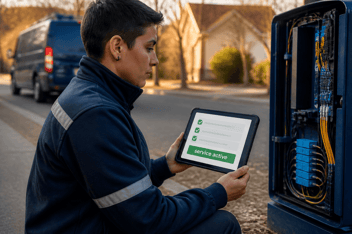
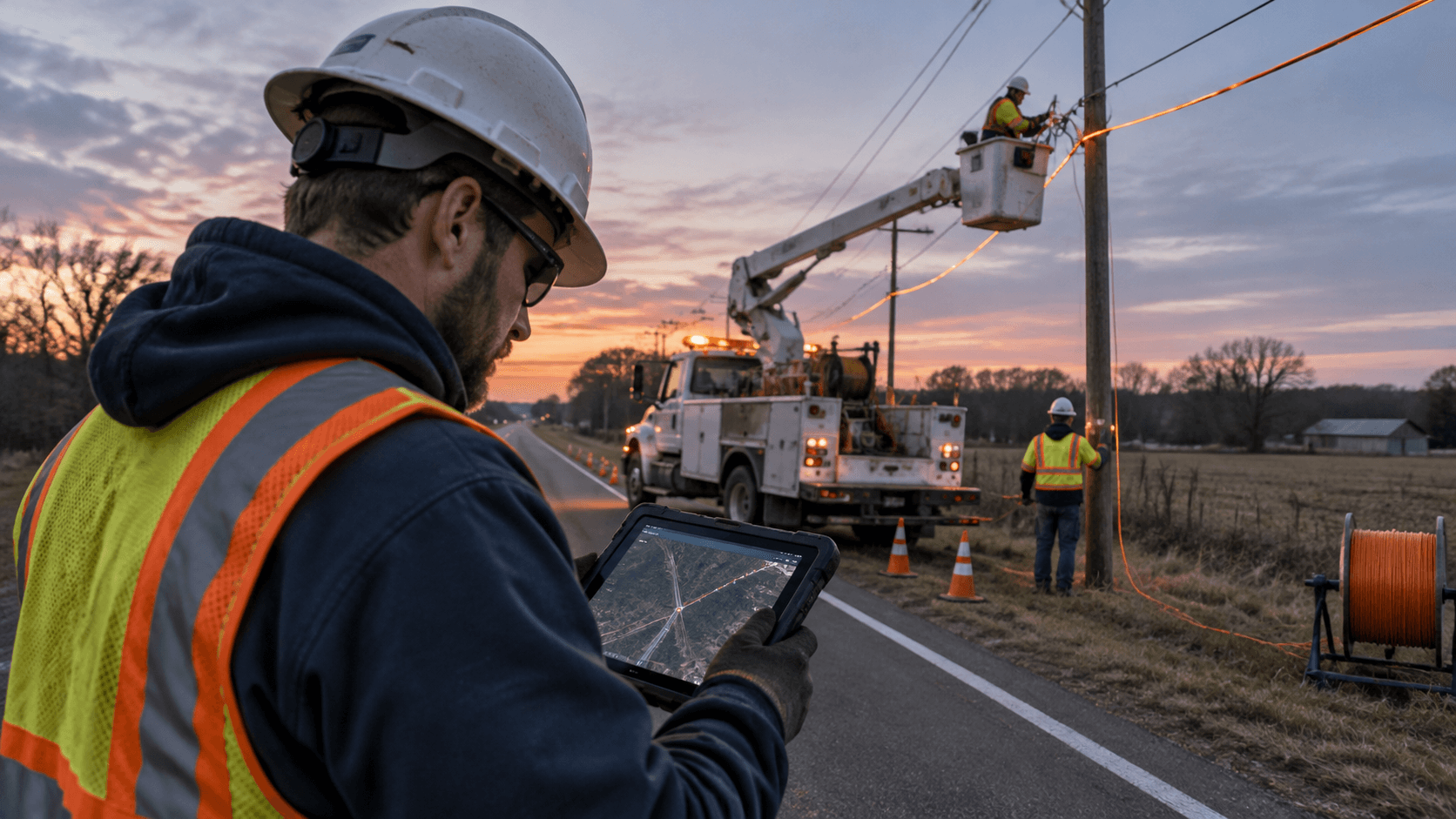
Most utilities I talk to aren't worried about building fiber. They've been stringing cable on poles, managing easements, and rolling trucks in bad weather for decades. What worries them is everything after the build: provisioning, subscriber billing, a helpdesk, and keeping all of it from tangling up the systems that keep the lights on.
That worry is fair. And it's the right place to focus.
More than 200 electric cooperatives are already involved in broadband deployment, according to NRECA's August 2026 filing with the FCC. But entering broadband hasn't been easy for everyone. NRECA told the Commerce Department that 63 co-ops won BEAD funding across 27 states, and nearly one in three have since pulled out, as Broadband Breakfast reported. Funding gets a network started. Operations decide whether it keeps going.
The good news for utilities is that you don't have to rip out your GIS, your CIS, or your work management to run fiber. You have to connect them to the right broadband layer. Here's how I'd think about each piece.
Start with the GIS you already trust
Your GIS is probably the most valuable thing you bring to broadband. Poles, conduit, right-of-way, and service territory are already mapped. Replacing that with a broadband-only mapping tool creates two versions of the truth, and they drift apart fast.
The better approach is to extend the GIS you have. AEX Field Service offers a zero-effort integration with Esri ArcGIS that works with both ArcGIS Enterprise and ArcGIS Online, so crews work against the same asset data your engineering team maintains. Field updates can go through approval workflows before they sync back to ArcGIS, so your GIS team stays in control of the record.
Treat fiber as another asset class, not a separate system
Utilities already think in assets: transformers, poles, substations, meters. Fiber strands, splice cases, cabinets, and ONTs fit the same model. If your broadband assets live in a different registry from your electric assets, every pole replacement becomes a coordination problem.
Enterprise asset management in AEX Field Service supports a native hierarchical asset registry or a direct connection to your ArcGIS asset database and ERP. Work orders can be created against any asset, so a pole job can show the fiber attached to it before a crew ever arrives.
Share crews without shortchanging either business
Using existing line crews for fiber work is one of the biggest cost advantages utilities have. It's also where things quietly go wrong. Fiber installs pile up, and reliability work slips. Or a storm hits, every crew goes to the electric side, and broadband installs stall for two weeks with no one telling subscribers why.
The fix is scheduling both kinds of work in one place. AEX Field Service schedules by route, technician location, and skill set, and it tracks certifications so the right people land on the right jobs. When you can see fiber and electric work side by side, you can make real tradeoffs instead of finding out after the fact.
Plan for storm response before the first storm
When the grid goes down, restoring power comes first. That won't change, and it shouldn't. But broadband subscribers still need to know what's happening, and fiber faults still need to be logged so they aren't lost once crews return.
Decide ahead of time how broadband work gets paused, reprioritized, and resumed during a major event. Who communicates with subscribers? Who watches the network while your people are on the electric side? A 24/7 NOC from AEX Network Services can keep monitoring the fiber network and coordinating repairs while your own crews focus on restoration.
Keep electric billing in your CIS. Run broadband billing beside it.
This is the question I hear most from utility finance teams: can we just bill broadband through our CIS? Technically, sometimes. Practically, it usually creates more work than it saves.
Utility CIS platforms are built around metered consumption. Broadband needs subscription plans, bundles, promotions, upgrades, and service changes that line up with provisioning. When billing can't see what the network is doing, revenue leaks in the gap between "installed" and "billed."
A cleaner model keeps the CIS as the system of record for electric accounts and runs broadband billing in a platform built for it. In AEX, field work closes the loop back to provisioning and billing automatically, so a finished install turns into a billed subscriber without someone re-keying it. The two systems don't have to be strangers, either. AEX connects to cloud and legacy systems through API, web services, flat file, or SFTP, with two-way updates, so customer and account data can move between your CIS, ERP, and broadband platform without double entry.
Don't let permitting and make-ready set your timeline
Utilities often own the poles. That helps, but it doesn't make permitting disappear. Road crossings, railroad crossings, state DOT permits, and make-ready work still drive the schedule. Rules are shifting too: in January 2026, the Commerce Department made compliance with FCC pole attachment rules a condition of BEAD grants, as Broadband Breakfast reported.
Track permits and make-ready as work against specific assets and routes, not in a separate spreadsheet. That way your build schedule, crew schedule, and serviceable-address list all reflect the same reality.
Use the fiber you already have
Many utilities aren't starting from zero. There's often existing fiber for SCADA, substation communications, or middle-mile links, sometimes with spare strands. That brownfield fiber can speed up a broadband launch, but only if it's documented in the same asset record as everything you build next.
Provisioning: where utility experience runs out
This is the one area most utilities haven't done before, and it's where I'd spend the most time evaluating vendors. Activating a subscriber means configuring an ONT, assigning a service profile, and confirming the connection works, ideally without anyone touching a keyboard.
AEX Software handles zero-touch provisioning across ten OEM ecosystems, including Nokia, Calix, Zhone, Ubiquiti, and Eero, plus any TR-069 device. That matters for utilities that want to choose equipment on price and support, not on what their software happens to accept. For a closer look at how platforms compare here, see our guide to the top OSS/BSS platforms for fiber and broadband operators.
What stays and what gets added
| Utility system | Keep it? | What broadband adds |
|---|---|---|
| GIS (Esri ArcGIS) | Yes, as the system of record | Fiber assets and field updates synced back to it |
| Asset management | Yes | Fiber, splice, and cabinet assets in the same hierarchy |
| Field crews | Yes, shared | One schedule for fiber and electric work by skill set |
| CIS / electric billing | Yes, for electric | Subscription billing tied to provisioning, connected by API or file sync |
| Outage and storm process | Yes | Broadband monitoring and subscriber updates during events |
| Network operations | Usually new | Provisioning, monitoring, and a helpdesk |
Start with the piece you need most
You don't have to adopt everything at once. AEX Software, AEX Field Service, and AEX Network Services each work on their own or together, and they're designed to sit alongside vendors you already use. A co-op with strong field operations might start with provisioning and billing. A municipality without a NOC might start with network services. Our page on launching a network walks through how operators get to their first invoice without assembling a full stack first.
Utilities bring something most new broadband entrants don't have: crews, assets, maps, and a long relationship with the community they serve. The goal isn't to replace any of that. It's to add the broadband layer without breaking what already works.
FAQ
Do utilities need to replace their GIS to launch fiber broadband?
No. A utility can keep its existing Esri ArcGIS environment as the system of record and connect broadband operations to it. AEX Field Service integrates with ArcGIS Enterprise and ArcGIS Online, so crews can work against the same asset data the utility already maintains.
Can a utility use the same field crews for power and fiber work?
Yes, many do. The key is scheduling both kinds of work in one place, with skills and certifications tracked per technician, so fiber installs don't quietly pull crews away from electric reliability work.
Should broadband billing run in the utility's existing CIS?
Usually not. Utility CIS platforms are built around metered consumption, while broadband needs subscription plans, bundles, and service changes tied to provisioning. Most utilities keep electric billing in the CIS, run broadband billing in a platform built for it, and connect the two through API, web services, flat file, or SFTP so data doesn't have to be entered twice.
What is the biggest operational risk for a utility entering broadband?
The handoffs between systems. Utilities usually have strong engineering and field capability. The gaps tend to show up between design, install, provisioning, and billing, where a subscriber can be physically connected but not yet activated or billed.
Can a utility adopt a broadband platform in phases?
Yes. AEX Software, AEX Field Service, and AEX Network Services can each be used on their own or together, and they are designed to work alongside vendors the utility already uses.