Unifying OSS/BSS Workflows: Boost Efficiency in Fiber Operations

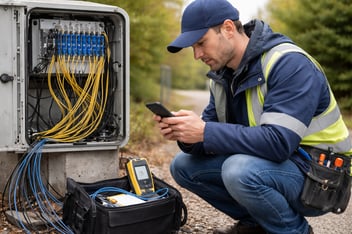
A technician completes an install. The work order closes. But the billing record doesn't update for three days because someone has to manually reconcile the completion data with the provisioning system. Meanwhile, another crew rolls to the same address for a follow-up that was already handled. This is what fragmented OSS/BSS workflows look like in practice.

For fiber operators managing thousands of subscribers, these disconnects between provisioning, dispatch, and billing are hiding in plain sight. They slow activations, create rework, and leak revenue at every handoff. AEX connects these critical workflows on a single platform, turning execution data into the operational system of record.

This guide walks you through the operational mechanics of unifying OSS/BSS workflows for fiber operations—from diagnosing where your current handoffs break down to building a connected provisioning-to-billing architecture that scales.

Key Takeaways: How to Unify OSS/BSS Workflows for Fiber Ops

  • Disconnected provisioning, dispatch, and billing workflows create delays, rework, and revenue leakage that compound as you scale.
  • Unified OSS/BSS architecture treats execution data as the system of record, triggering downstream processes automatically.
  • AEX connects every layer of fiber operation—from service qualification through billing—on a single native platform.
  • Zero-touch provisioning eliminates manual configuration steps that slow activations and introduce errors.
  • Real-time field data capture ensures billing reflects what was actually delivered, reducing disputes and shortening order-to-cash cycles.

What Does Unified OSS/BSS Mean for Fiber Operations?

The term "unified OSS/BSS" gets used frequently. Most of the time, it means a CRM pulling data from multiple systems into a dashboard. That is useful. But it falls well short of what fiber operators need to scale.

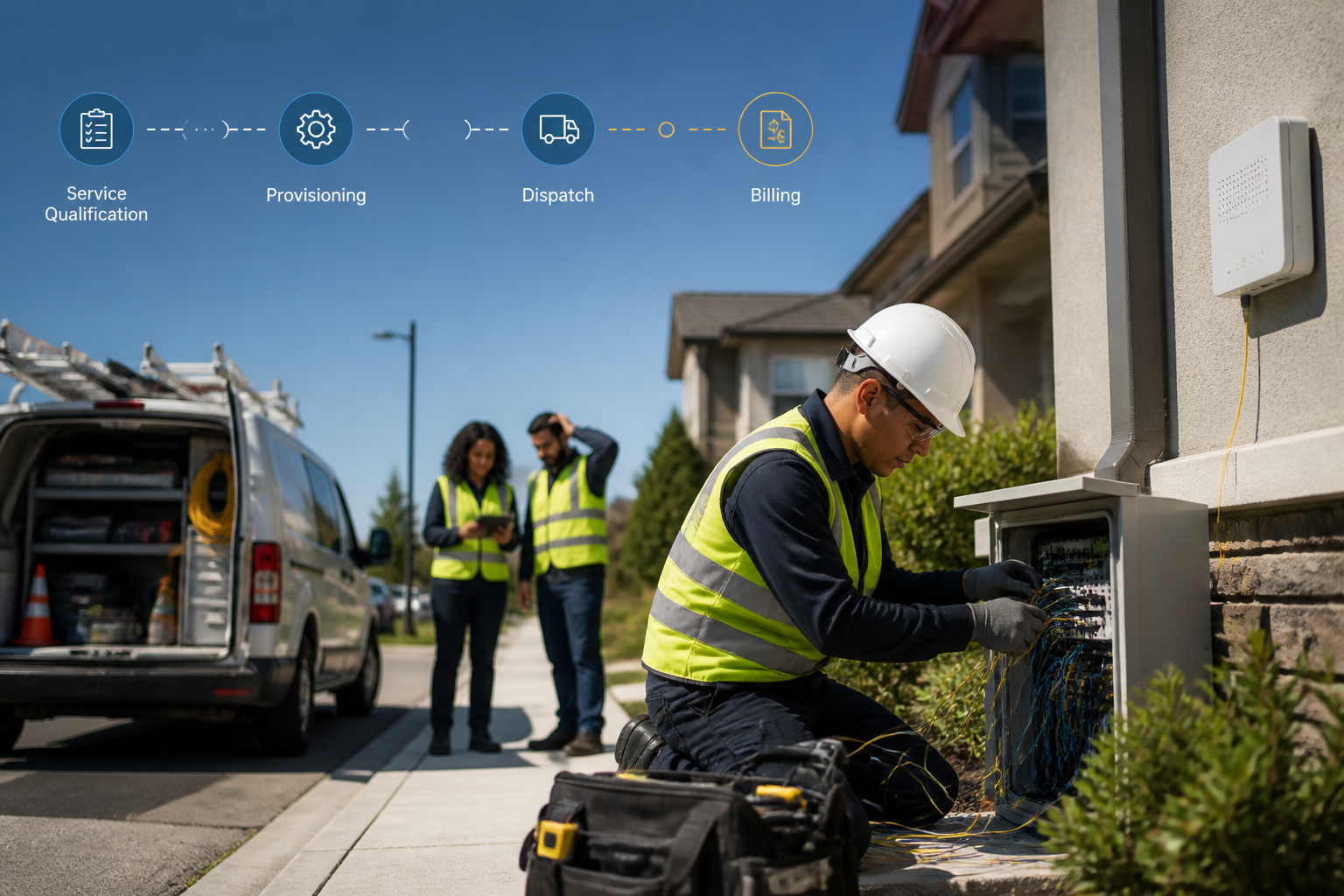
A genuinely unified OSS/BSS architecture connects the operational layers that matter: service qualification, provisioning, dispatch, field execution, network activation, and billing. Data flows between these layers without manual reconciliation or system-to-system exports.

In practice, this means a completed installation automatically triggers device provisioning, updates the subscriber record, initiates billing, and closes the work order—all from the same execution event captured in the field.

Why Traditional OSS/BSS Architectures Fragment Over Time

Most fiber operators don't start with fragmented systems on purpose. They acquire best-fit tools for each operational layer: one platform for network inventory, another for dispatch, a third for billing, and a fourth for customer management.

Each system works well in isolation. The problems emerge at handoffs. Provisioning data doesn't flow cleanly into dispatch. Completion records require manual entry into billing. Network activation status lives in a portal disconnected from customer service.

According to Ericsson's OSS/BSS overview, telecom operators face increasing pressure to modernize operations as legacy architectures create data silos that slow decision-making and increase operational costs.

The Hidden Costs of Disconnected Provisioning, Dispatch, and Billing

Fragmentation creates three categories of operational drag: delays, rework, and revenue leakage. The same inefficiencies that slow a 5,000-subscriber operation become serious financial exposure at 50,000.

Delays: When Handoffs Stall Activations

Every time data moves between systems manually, you add time to the activation cycle. A service order that requires manual provisioning entry, followed by manual dispatch assignment, followed by manual billing setup, can take days longer than it should.

For subscribers waiting to come online, those delays affect satisfaction and increase the window for churn before service even starts. For your operations team, they create backlogs that compound during high-volume build periods.

Rework: When Missing Data Sends Trucks Back

A technician arrives at a premise. The work order says "install fiber." But it doesn't specify which ONT model, which service tier, or whether inside wiring is required. The tech calls dispatch. Dispatch calls provisioning. The job gets rescheduled.

This is not a people problem. It is a tools problem. When work orders don't reflect the full network and service context, techs lack what they need to complete jobs on the first visit. Repeat visits cost fuel, labor, and subscriber goodwill.

Revenue Leakage: When Billing Doesn't Match Delivery

Revenue leakage happens when billing records fall out of sync with what was actually delivered in the field. A subscriber gets upgraded during an install, but the billing system still shows the original tier. A completed activation doesn't trigger invoicing for three weeks.

The TelecomHall analysis on legacy OSS/BSS costs highlights how these reconciliation gaps create revenue recognition delays and increase billing disputes as operators scale.

The Three Layers of OSS/BSS Workflow Unification

Unifying OSS/BSS workflows for fiber operations requires connecting three operational layers: service readiness, field execution, and revenue operations. Each layer has specific integration requirements.

Layer 1: Service Readiness (Qualification and Provisioning)

Service readiness covers everything that happens before a truck rolls. It includes address qualification, network design, product configuration, and device provisioning.

In a unified architecture, service readiness data flows directly into work order creation. When you qualify an address, the system knows what network infrastructure serves that premise, what services are available, and what equipment is required for installation.

Zero-touch provisioning takes this further. Once an order is placed, the platform pre-configures the ONT or CPE based on the service profile. The device arrives ready to activate, eliminating manual configuration steps that slow installations.

Layer 2: Field Execution (Dispatch and On-Site Work)

Field execution is where plans meet reality. Dispatch assigns crews, technicians travel to premises, and work gets completed—or it doesn't.

The key to unified field execution is bidirectional data flow. Work orders carry full context from service readiness: what network port to use, what equipment to install, what tests to run. Completion data flows back immediately: photos, GPS stamps, test results, material usage.

AEX's Field Squared platform captures execution data in real time, including offline capability for rural builds where connectivity is spotty. That data becomes the operational system of record.

Layer 3: Revenue Operations (Billing and Subscriber Management)

Revenue operations close the loop. When a technician marks a job complete and the network confirms device connectivity, billing should trigger automatically. No manual reconciliation. No waiting for batch uploads.

This is where execution data as the system of record matters most. Billing reflects what was actually delivered in the field, not what was ordered. Service tier changes made during installation update the subscriber record immediately. Revenue recognition aligns with actual service delivery.

How to Assess Your Current OSS/BSS Workflow Fragmentation

Before you can unify workflows, you need to understand where your current handoffs break down. This assessment framework helps you identify the highest-impact integration gaps.

Map Your Data Flow from Order to Invoice

Start by tracing a single service order through your entire operation. Document every system touch, every manual entry, and every data export/import between platforms.

Key questions to answer:

  • How many systems does order data pass through before a truck rolls?
  • How does provisioning information reach the technician in the field?
  • What triggers billing after installation completion?
  • Where do you rely on batch processes or manual reconciliation?

Identify Time-to-Activation Bottlenecks

Measure the elapsed time between key operational milestones: order received to truck dispatched, dispatch to job completion, completion to network activation, activation to first invoice.

Compare actual times against what should be possible with direct system-to-system data flow. The gaps reveal where fragmentation costs you the most.

Quantify Your Rework Rate

Track how many jobs require follow-up visits due to incomplete information, wrong equipment, or missing network context. Every rework visit represents a workflow handoff that failed.

Also track jobs where technicians call back to dispatch or provisioning for clarification. These "soft" failures don't generate repeat truck rolls, but they extend handle time and reduce daily job capacity.

Audit Your Billing Reconciliation Process

How long after installation does a subscriber's first invoice go out? How often do billing records require manual adjustment to match field completion data? What percentage of billing disputes trace back to execution-to-billing mismatches?

These metrics expose the revenue impact of disconnected workflows.

Building a Unified Provisioning-to-Dispatch-to-Billing Workflow

With your fragmentation points mapped, you can design a unified workflow architecture. The goal is eliminating manual handoffs between provisioning, dispatch, and billing while maintaining the operational flexibility fiber deployments require.

Step 1: Establish a Single Product Catalog

Every service you offer—every speed tier, equipment option, and add-on—should live in a single product catalog that feeds both order entry and billing. When sales configures an order, billing rules are already attached.

This eliminates the common failure mode where sales sells a package that billing doesn't recognize, or where service tiers have different names in different systems.

Step 2: Connect Service Qualification to Work Order Creation

When an address qualifies for service, your system should know what network infrastructure serves that premise, what fiber distribution hub it connects to, and what equipment inventory is available.

Work orders should generate with full context: network assignment, equipment requirements, installation instructions, and test parameters. The technician sees everything they need without calling back for clarification.

Step 3: Enable Real-Time Field Data Capture

Equip your field teams with mobile tools that capture execution data as work happens. Photos of completed installations, GPS coordinates confirming premise location, test results validating signal levels, material serial numbers linking equipment to subscriber records.

This data should sync immediately—or queue for sync when connectivity returns. The Intellias analysis on OSS/BSS automation emphasizes that real-time field data integration is foundational to reducing the manual reconciliation that slows scaling operators.

Step 4: Automate Downstream Processes from Completion Events

When a technician marks a job complete and required data is captured, downstream processes should trigger automatically:

  • Device provisioning commands push to the network element
  • Subscriber status updates to "active" in customer records
  • Billing cycle starts based on verified activation date
  • Welcome communications send to the subscriber
  • Work order closes in dispatch system

No manual reconciliation. No batch exports. The execution event drives everything downstream.

Step 5: Validate Data Before Billing Triggers

Automated doesn't mean unvalidated. Build validation rules that catch incomplete or conflicting data before it reaches billing. If a completion record is missing required photos, flag it for review rather than triggering an invoice.

This creates confidence in billing accuracy while still automating the happy path where data is complete.

Zero-Touch Provisioning: Eliminating Manual Configuration Delays

Zero-touch provisioning is a specific capability that accelerates activations by pre-configuring customer premises equipment before installation. Instead of technicians entering configuration details on-site, devices arrive ready to connect.

How Zero-Touch Provisioning Works

When an order is placed, the OSS/BSS platform generates a provisioning profile based on the service configuration. That profile includes VLAN assignments, speed parameters, voice settings, and any subscriber-specific customizations.

The profile attaches to a specific device serial number. When the technician plugs in the ONT or router, it contacts the provisioning server, downloads its configuration, and comes online with the correct service parameters.

Operational Benefits of Zero-Touch Activation

Zero-touch provisioning reduces average installation time by eliminating manual configuration steps. Technicians focus on physical installation—running drops, mounting equipment, testing signal levels—while software handles service activation.

It also reduces configuration errors. Manual entry of MAC addresses, service parameters, and network assignments creates opportunities for typos and mismatches. Automated provisioning applies consistent rules across every activation.

AEX OSS/BSS supports zero-touch provisioning across Active Ethernet, PON, and Fixed Wireless network architectures, syncing configuration profiles from the product catalog to device activation without manual intervention.

Connecting Field Execution Data to Your OSS/BSS Platform

Field execution data—what actually happened at the premise—is the connective tissue between planning and billing. When execution data flows directly into your OSS/BSS, you eliminate the reconciliation steps that create delays and errors.

What Field Execution Data to Capture

Effective field data capture goes beyond job status. Key data elements include:

  • Completion evidence: Photos of installed equipment, cable routing, and premise conditions
  • Location verification: GPS coordinates confirming work location matches service address
  • Test results: Signal levels, throughput measurements, and device connectivity verification
  • Material usage: Serial numbers of installed equipment linked to subscriber record
  • Time stamps: Arrival, work start, completion, and departure times for labor tracking
  • Exception notes: Documentation of any issues or deviations from standard procedure

Making Field Data the System of Record

In most operator environments, the "official" record of what happened lives in backend systems that field teams update indirectly—often through manual data entry after returning from jobs.

When field data becomes the system of record, the dynamic reverses. What the technician captured in real time during execution is the authoritative source. Backend systems update from field data, not the other way around.

This shift improves data accuracy and reduces the lag between field completion and operational visibility. Managers see job status in real time rather than waiting for end-of-day reconciliation.

Automating the Order-to-Cash Cycle for Fiber Operators

Order-to-cash measures the elapsed time from when a subscriber places an order to when you collect payment. For fiber operators, this cycle involves service qualification, provisioning, installation, activation, and billing—each traditionally handled by separate systems.

Where Order-to-Cash Cycles Break Down

The most common breakdowns occur at workflow handoffs:

  • Order to provisioning: Manual service setup delays work order creation
  • Provisioning to dispatch: Work orders lack network context, causing rework
  • Dispatch to billing: Completion data requires manual entry before invoicing
  • Billing to collection: Invoice errors from data mismatches delay payment

Compressing Order-to-Cash Through Workflow Integration

When provisioning, dispatch, and billing share a common data layer, each handoff becomes automatic. Order placement triggers service configuration. Configuration completion triggers work order creation. Job completion triggers billing activation.

The result is faster time to revenue and fewer billing disputes. When your invoice matches exactly what the subscriber ordered and the technician delivered, disagreements drop.

AEX delivers 60%+ faster time to invoice by connecting service qualification, provisioning, activation, and billing workflows on a single platform. Completion data flows directly into customer and billing records without manual reconciliation.

Network Monitoring Integration: Aligning Activation With Network Reality

Unified OSS/BSS extends beyond provisioning and billing to include network monitoring. When your operations platform sees real-time network status, you can validate activations, detect issues before subscribers call, and improve field service routing.

Validating Activations Through Network Status

A technician marks a job complete, but did the device actually come online? Network monitoring integration answers that question automatically. If the ONT registered with the OLT and established connectivity, activation is confirmed. If not, the system can flag the job for follow-up before the technician leaves the area.

Detecting Issues Before Subscriber Impact

Network monitoring data flowing into your OSS/BSS enables proactive support. If a subscriber's device shows degraded signal or intermittent connectivity, you can dispatch a technician before the subscriber experiences a service outage.

This shifts your support model from reactive to proactive—reducing inbound call volume and improving subscriber satisfaction scores.

Improving Field Service Routing With Network Context

When dispatchers see network status alongside work orders, they can make smarter routing decisions. If multiple trouble tickets trace to the same fiber distribution hub, you can dispatch a single crew to investigate the common cause rather than sending separate technicians to each premise.

Scaling Unified OSS/BSS Workflows Across Multi-State Operations

What works for a single-market fiber operator may not scale across multiple states and hundreds of thousands of passings. Unified workflows need to accommodate regional variations while maintaining operational consistency.

Managing Regional Variations in Network and Equipment

Different markets may use different network architectures (PON vs. Active Ethernet), different equipment vendors, or different service configurations based on local competitive dynamics.

Your unified OSS/BSS should handle these variations through configurable service catalogs and network profiles rather than separate system instances. One platform, multiple configurations.

Maintaining Consistency With Distributed Field Teams

As you expand, you'll likely work with a mix of employee technicians and contractor crews across different regions. Unified workflows ensure consistent processes regardless of who performs the work.

AEX enables this through encoded workflows—checklists, documentation requirements, and provisioning steps built into the platform. Contract crews follow the same procedures as internal teams, and completion data flows into the same system of record.

Supporting Acquisitions Without Operational Disruption

Growth through acquisition adds complexity. The acquired operator has existing subscribers, equipment, and workflows that need to merge with your operations.

A unified OSS/BSS platform supports this by separating data migration from operational continuity. You can bring subscriber records and network inventory into the new system while maintaining service continuity during transition.

Measuring the Impact of Unified OSS/BSS Workflows

How do you know if workflow unification is delivering results? Track these operational and financial metrics before and after implementation.

Operational Metrics

  • Time to activation: Days from order to live service
  • First-visit completion rate: Percentage of jobs completed without follow-up
  • Technician daily capacity: Jobs completed per tech per day
  • Dispatch-to-completion time: Hours from assignment to job closure
  • Manual reconciliation hours: Staff time spent matching data across systems

Financial Metrics

  • Order-to-cash cycle time: Days from order to payment collection
  • Revenue leakage rate: Percentage of delivered services not billed correctly
  • Billing dispute rate: Percentage of invoices requiring adjustment
  • Truck roll cost per install: Total field cost including rework visits

What to Expect From Workflow Unification

Operators who unify provisioning, dispatch, and billing workflows typically see 2x to 3x improvement in technician throughput through better scheduling, route optimization, and reduced rework. Order-to-cash cycles compress by 60% or more when manual reconciliation steps disappear.

The impact compounds as you scale. The same fragmentation that creates minor inefficiencies at 5,000 subscribers becomes serious revenue exposure at 50,000.

Implementation Approaches: Unified Platform vs. Integration Layer

There are two architectural approaches to OSS/BSS workflow unification: adopting a unified platform that handles all operational layers natively, or building an integration layer that connects existing best-of-breed systems.

The Unified Platform Approach

A unified platform handles service qualification, provisioning, dispatch, field execution, billing, and subscriber management on a single native architecture. Data flows between functions without API calls or middleware.

Benefits include faster implementation, lower integration maintenance, and inherent data consistency. The tradeoff is replacing existing systems rather than extending them.

AEX takes this approach—connecting every layer of fiber operation on a single native platform. From serviceable address verification through billing, data moves through one system of record.

The Integration Layer Approach

An integration layer preserves existing best-of-breed systems while adding middleware that orchestrates data flow between them. Each system continues to handle its functional area, with the integration layer managing handoffs.

Benefits include preserving existing investments and allowing gradual migration. The tradeoff is ongoing integration maintenance, potential latency in data flow, and the complexity of managing multiple vendor relationships.

Choosing the Right Approach for Your Operation

The right approach depends on your current system maturity, growth trajectory, and operational complexity. Operators with deeply embedded legacy systems may start with integration while planning longer-term platform consolidation. Operators building greenfield or experiencing rapid growth often benefit from unified platforms that scale without integration debt.

FAQs About How to Unify OSS/BSS Workflows for Fiber Ops

What is an OSS/BSS platform in fiber broadband?

An OSS/BSS platform manages the operational and business support functions for fiber networks. OSS handles network-facing operations like provisioning, activation, and monitoring. BSS handles subscriber-facing functions like billing, order management, and customer service. Unified platforms combine both layers.

How does unified OSS/BSS reduce revenue leakage?

Revenue leakage occurs when delivered services don't trigger accurate billing. Unified OSS/BSS eliminates this by connecting field execution data directly to billing records. When a technician completes an install, AEX automatically updates billing to reflect the exact services delivered, removing manual reconciliation delays.

What is zero-touch provisioning for fiber networks?

Zero-touch provisioning pre-configures customer premises equipment before installation. When an order is placed, the platform generates a configuration profile tied to the device serial number. On connection, the device downloads its settings automatically. AEX OSS/BSS supports zero-touch provisioning across PON, Active Ethernet, and Fixed Wireless networks.

How long does it take to unify OSS/BSS workflows?

Implementation timelines depend on operational complexity and data migration requirements. AEX offers rapid implementation timelines due to fully integrated data, workflows, and field operations built into a single platform. Most fiber operators complete deployment in weeks rather than months.

Can unified OSS/BSS handle multiple network architectures?

Yes. Modern unified platforms support multiple network types through configurable service catalogs and provisioning profiles. AEX is vendor-agnostic and supports Active Ethernet, PON, and Fixed Wireless architectures on the same platform, with automated workflows and network monitoring for each.

How does field execution data integrate with OSS/BSS?

Field execution data integrates through mobile applications that capture work completion in real time. Technicians document installations with photos, GPS, test results, and material serial numbers. AEX Field Squared syncs this data immediately—even with offline capability—making execution data the operational system of record.

What metrics improve after OSS/BSS workflow unification?

Key improvements include faster time to activation, higher first-visit completion rates, and compressed order-to-cash cycles. AEX customers typically see 2x to 3x technician throughput improvement and 60%+ faster time to invoice through connected provisioning, dispatch, and billing workflows.