
A subscriber signs up for service. A technician completes the install. Two weeks later, billing still shows the account as pending. The support team is on the phone with network ops, trying to figure out what went wrong.
This is not a rare edge case. For many telecom operators, it is the daily reality of running disconnected systems. Provisioning sits in one platform. Dispatch in another. Billing in a third. AEX connects these operational layers through zero touch automation, turning what used to be a multi-day reconciliation problem into a workflow that moves from order to revenue without manual handoffs.
In this article, you will learn what zero touch OSS BSS actually means, why fragmented systems create operational drag, and how connected workflows reduce delays, rework, and revenue leakage.
Key Takeaways: How Zero Touch OSS BSS Improves Telecom Operations
- Zero touch provisioning automates device activation and service configuration, removing the manual steps that slow order completion.
- Fragmented OSS and BSS systems create handoff gaps where data gets lost, leading to billing errors and subscriber frustration.
- AEX unifies provisioning, dispatch, and billing on a single platform so execution data flows automatically to downstream systems.
- Connected workflows shorten order-to-cash cycles by ensuring completed work triggers billing without human intervention.
- Operators gain real-time visibility into service status, reducing support escalations and improving first-call resolution.
Zero touch provisioning means a network device configures itself automatically the moment it connects, no manual login to a provisioning portal, no copying serial numbers between systems, no waiting on a network engineer to push a config file. I've covered what that actually requires at the infrastructure level elsewhere. What matters here is what happens next: how that automatic activation connects to dispatch and billing so the whole operation scales without scaling headcount.
Why Fragmented OSS/BSS Creates Operational Drag
Most telecom operators did not set out to build fragmented systems. They added tools as needs emerged. One platform for service qualification. Another for network inventory. A third for field dispatch. A fourth for billing.
The problem is not any single tool. The problem is the gaps between them. When a technician marks a job complete in the dispatch system, that data does not automatically update provisioning status. Billing does not know the service is active.
According to research from TelecomHall, these system gaps create scaling bottlenecks that compound as operators grow. What starts as a minor delay at 5,000 subscribers becomes a serious revenue leak at 50,000.
Where Handoff Gaps Create Revenue Leakage
Revenue leakage hides in the gaps between systems. A completed installation sits unbilled because the work order status never reached the billing engine. A subscriber receives service for two weeks before the first invoice goes out.
Multiply that across hundreds of installs per month and the financial impact adds up fast. The data existed in the field. It just never made it to finance.
How Zero Touch Workflows Connect Provisioning, Dispatch, and Billing
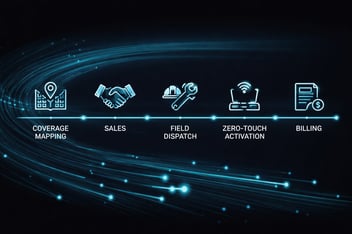
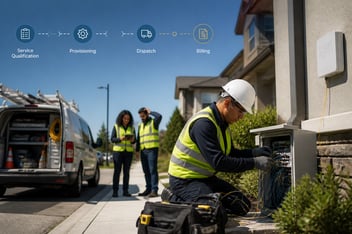
A zero touch OSS BSS platform connects the full service lifecycle. When a subscriber places an order, the system qualifies the address, schedules the install, provisions the network port, and stages the work order for the field team.
Once the technician completes the job and captures the required data, the platform confirms the device is online, updates the subscriber record, and triggers the billing cycle. No manual reconciliation. No waiting for someone to close the loop.
AEX handles this by treating execution data as the connective tissue between business functions. The AEX OSS/BSS platform syncs data from field completion directly into provisioning and billing workflows, so the systems stay aligned without manual intervention.
What Changes When Execution Data Flows Automatically
With connected workflows, order-to-cash cycles shorten. You stop chasing down work orders to confirm what was actually installed. Support teams see real-time service status instead of guessing whether the subscriber is active.
Handle time drops. Escalations drop. Billing disputes become less frequent because invoices reflect what was actually delivered in the field.
The Role of Network Monitoring in Zero Touch Operations
Zero touch is not just about initial provisioning. It extends to day-2 operations. When a subscriber calls about a service issue, your support team needs to know whether the device is online, what the connection quality looks like, and whether they can reboot or reprovision remotely.
A unified platform gives your team that visibility without leaving the screen. They pull up the subscriber record and see network status alongside service history, open work orders, and billing details.
AEX integrates network monitoring directly into the subscriber view, so agents can diagnose and resolve issues faster. That means fewer truck rolls for problems that could have been fixed remotely.
Reducing Delays and Rework Through Automation
Delays compound. A missed provisioning step means a reschedule. A reschedule means a truck roll. A truck roll means cost and subscriber frustration. Zero touch automation removes the manual steps where errors creep in.
According to Circles, telco transformation requires integrated OSS/BSS to connect operational workflows. When provisioning, dispatch, billing, and network operations share the same data layer, you reduce the rework that comes from system mismatches.
How Automation Improves Technician Throughput
When technicians arrive on site with complete job context, they spend less time troubleshooting surprises. The work order reflects real network and service data. The provisioning is staged. The equipment is confirmed.
This translates to more jobs completed per day. Fewer return visits. Higher first-time completion rates.
What to Expect When Implementing Zero Touch OSS/BSS
Moving to a unified platform does not mean ripping out existing systems overnight. Many operators take an incremental approach, connecting high-impact workflows first and expanding over time.
The key is ensuring your platform can sync with existing tools while you migrate. AEX enables incremental modernization by integrating with your current stack and automating workflows without requiring a full system replacement.
Implementation timelines depend on complexity, but operators typically see the fastest impact in provisioning and billing alignment, where manual handoffs create the most immediate drag.
In Conclusion: How Zero Touch OSS/BSS Reduces Operational Drag
Zero touch OSS BSS is not about removing humans from the process. It is about removing the manual steps that slow you down. Provisioning that triggers automatically. Billing that reflects actual delivery. Support teams that see the full picture without opening four tabs.
For telecom operators scaling their subscriber base, connected workflows turn growth from a risk into a controlled outcome. The same data that captures what happened in the field flows into the systems that run your business.
Want to see how AEX connects provisioning, dispatch, and billing on a single platform? Request a demo today.
FAQs About Zero Touch OSS/BSS for Telecom Operations
What does zero touch provisioning mean for telecom operators?
A network device configures itself automatically when connected, no manual portal login, no pushed config files. For fiber operators this speeds up activation and cuts errors during high-volume installs. See the full technical breakdown for how it actually works at the ONT and authentication level.
How does a unified OSS/BSS platform reduce revenue leakage?
Revenue leakage happens when completed work does not reach billing systems. A unified platform ensures execution data flows automatically from the field to finance.
AEX treats field completion as the trigger for downstream billing, so invoices go out based on what was actually delivered rather than what someone remembered to enter.
Can zero touch OSS/BSS work with my existing systems?
Yes. Most operators run multiple platforms for different functions. A modern OSS/BSS solution should integrate with your existing tools while automating the handoffs between them.
AEX connects to your current stack and syncs data across systems, allowing you to modernize incrementally without replacing everything at once.
How does network monitoring fit into a zero-touch OSS/BSS workflow?
Network monitoring is what catches a fault before dispatch does. In a connected workflow, a network event doesn't wait for a customer complaint, it becomes a dispatched job directly, with the technician arriving already knowing what's wrong. That's a different problem than provisioning speed, but it runs on the same principle: nothing in the middle waiting for a person to notice and act.
How does zero touch automation improve technician productivity?
Technicians arrive with complete job context when work orders reflect real network data. Provisioning is staged before they reach the site, so activation happens immediately after installation.
AEX captures execution data in real time and triggers provisioning automatically, reducing the back-and-forth that slows down field teams. AEX customers sustain three to five installs per technician per day, a 2-3x improvement over unintegrated operations.