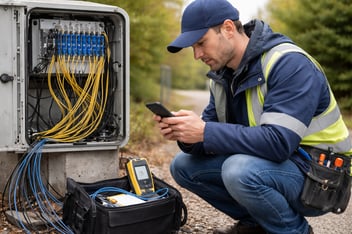
A technician completes an install. The work order closes. But the billing record doesn't update for three days because someone has to manually reconcile the completion data with the provisioning system. Meanwhile, another crew rolls to the same address for a follow-up that was already handled. This is what fragmented OSS/BSS workflows look like in practice.
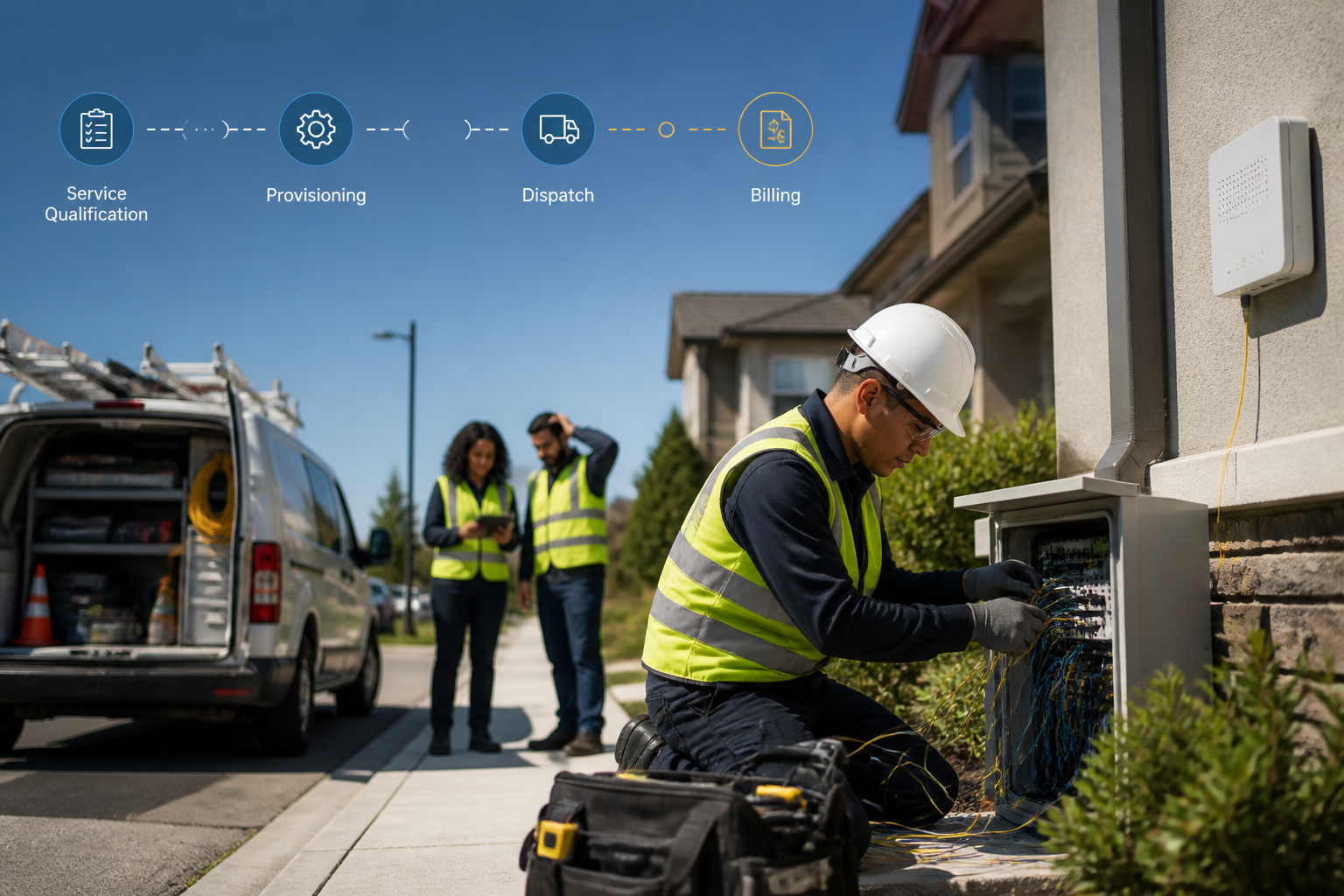
For fiber operators managing thousands of subscribers, these disconnects between provisioning, dispatch, and billing are hiding in plain sight. They slow activations, create rework, and leak revenue at every handoff. AEX Inc connects these critical workflows on a single platform, turning execution data into the operational system of record.
This guide walks you through the operational mechanics of unifying OSS/BSS workflows for fiber operations, from diagnosing where your current handoffs break down to building a connected provisioning-to-dispatch-to-billing workflow.
Key Takeaways
- Disconnected provisioning, dispatch, and billing workflows create delays, rework, and revenue leakage that compound as you scale.
- Unified OSS/BSS architecture treats execution data as the system of record, triggering downstream processes automatically.
- AEX Inc connects every layer of fiber operation, from service qualification through billing and network infrastructure/management, on a single native platform.
- Zero-touch provisioning eliminates manual configuration steps that slow activations and introduce errors.
- Real-time field data capture ensures billing reflects what was actually delivered, reducing disputes and shortening order-to-cash cycles.
What Does Unified OSS/BSS Mean for Fiber Operations?
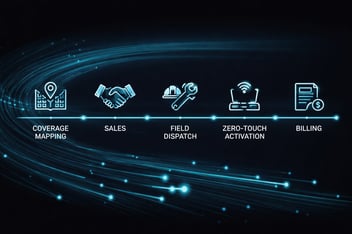
The term "unified OSS/BSS" gets used frequently. Most of the time, it means a CRM pulling data from multiple systems into a dashboard, useful, but well short of what fiber operators need to scale. A genuinely unified OSS/BSS architecture connects the operational layers that matter: service qualification, provisioning, dispatch, field execution, network activation, and billing. Data flows between these layers without manual reconciliation or system-to-system exports. In practice, a completed installation automatically triggers device provisioning, updates the subscriber record, initiates billing, and closes the work order, all from the same execution event captured in the field.
Why Traditional OSS/BSS Architectures Fragment Over Time
Most fiber operators don't start with fragmented systems on purpose. They acquire best-fit tools for each operational layer: one platform for network inventory, another for dispatch, a third for billing, a fourth for customer management. Each system works well in isolation, the problems emerge at the handoffs. Provisioning data doesn't flow cleanly into dispatch. Completion records require manual entry into billing. Network activation status lives in a portal disconnected from customer service.
The Three Layers of OSS/BSS Workflow Unification
Unifying OSS/BSS workflows requires connecting three operational layers, each with specific integration requirements:
- Service Readiness — qualification and provisioning
- Field Execution — dispatch and on-site work
- Revenue Operations — billing and subscriber management
How to Assess Your Current OSS/BSS Workflow Fragmentation
Before unifying workflows, map where your current handoffs break down:
- Map your data flow from order to invoice
- Identify time-to-activation bottlenecks
- Quantify your rework rate
- Audit your billing reconciliation process
Building a Unified Provisioning-to-Dispatch-to-Billing Workflow
With fragmentation points mapped, design a unified workflow architecture that eliminates manual handoffs while maintaining the operational flexibility fiber deployments require:
- Establish a single product catalog
- Connect service qualification to work order creation
- Enable real-time field data capture
- Automate downstream processes from completion events
- Validate data before billing triggers
Zero-Touch Provisioning: Eliminating Manual Configuration Delays
Zero-touch provisioning pre-configures customer premises equipment before installation. Instead of technicians entering configuration details on-site, devices arrive ready to connect, and activation triggers automatically from the completed installation event.
Connecting Field Execution Data to Your OSS/BSS Platform
Field execution data becomes the operational system of record when technicians capture it in real time: photos, GPS stamps, test results, material usage. AEX Inc's platform captures this execution data as it happens, including offline capability for rural builds where connectivity is spotty, and that data drives every downstream process automatically.
Automating the Order-to-Cash Cycle for Fiber Operators
Order-to-cash cycles break down wherever a handoff requires manual reconciliation. Compressing the cycle means connecting service qualification, field execution, and billing so a completion event triggers the next step automatically instead of waiting on someone to notice and act on it.
Network Infrastructure & Monitoring Integration: Aligning Activation With Network Reality
Unified OSS/BSS extends beyond provisioning and billing to include network infrastructure and monitoring. When your operations platform sees real-time network status, you can validate activations, detect issues before subscribers call, and improve field service routing, this is also where AEX Inc's integrated network management capability differs from platforms that treat network monitoring as a separate, disconnected tool.
Scaling Unified OSS/BSS Workflows Across Multi-State Operations
Scaling unified workflows across regions means managing regional variations in network and equipment, maintaining consistency across distributed field teams, and supporting acquisitions without operational disruption, all of which get harder, not easier, on a fragmented stack.
Measuring the Impact of Unified OSS/BSS Workflows
Track these operational and financial metrics before and after implementation:
- Operational metrics: time to activation, first-visit completion rate, rework rate
- Financial metrics: order-to-cash cycle time, billing dispute rate, revenue leakage
Implementation Approaches: Unified Platform vs. Integration Layer
There are two architectural approaches to OSS/BSS workflow unification:
- Unified platform approach: one platform handles all operational layers natively
- Integration layer approach: connect existing best-of-breed systems through an integration layer
The right approach depends on your current system maturity, growth trajectory, and operational complexity. Operators with deeply embedded legacy systems may start with integration while planning longer-term platform consolidation. Operators building greenfield or experiencing rapid growth often benefit from unified platforms that scale without integration debt.
Frequently Asked Questions
What is an OSS/BSS platform in fiber broadband? An OSS/BSS platform manages the operational and business support functions for fiber networks. OSS handles network-facing operations like provisioning, activation, and monitoring. BSS handles subscriber-facing functions like billing, order management, and customer service. Unified platforms combine both layers.
How does unified OSS/BSS reduce revenue leakage? Revenue leakage occurs when delivered services don't trigger accurate billing. Unified OSS/BSS eliminates this by connecting field execution data directly to billing records. When a technician completes an install, AEX Inc automatically updates billing to reflect the exact services delivered, removing manual reconciliation delays.
What is zero-touch provisioning for fiber networks? Zero-touch provisioning pre-configures customer premises equipment before installation. When an order is placed, the platform generates a configuration profile tied to the device serial number. On connection, the device downloads its settings automatically. AEX Inc's OSS/BSS platform supports zero-touch provisioning across PON, Active Ethernet, and Fixed Wireless networks.
How long does it take to unify OSS/BSS workflows? Implementation timelines depend on operational complexity and data migration requirements. AEX Inc offers rapid implementation timelines due to fully integrated data, workflows, and field operations built into a single platform. Most fiber operators complete deployment in weeks rather than months.
Can unified OSS/BSS handle multiple network architectures? Yes. Modern unified platforms support multiple network types through configurable service catalogs and provisioning profiles. AEX Inc is vendor-agnostic and supports Active Ethernet, PON, and Fixed Wireless architectures on the same platform, with automated workflows and network infrastructure/monitoring for each.
How does field execution data integrate with OSS/BSS? Field execution data integrates through mobile applications that capture work completion in real time. Technicians document installations with photos, GPS, test results, and material serial numbers. AEX Inc syncs this data immediately, even with offline capability, making execution data the operational system of record. (Corrected from "AEX Field Squared" in the original — see branding note above.)
What metrics improve after OSS/BSS workflow unification? Key improvements include faster time to activation, higher first-visit completion rates, and compressed order-to-cash cycles. AEX Inc customers typically see 2x to 3x technician throughput improvement and 60%+ faster time to invoice through connected provisioning, dispatch, billing, and network management workflows.
time to invoice through connected provisioning, dispatch, and billing workflows.