
Last updated: November 2026
Quick answer: The most common field service bottlenecks in fiber operations are reactive scheduling, slow provisioning, poor visibility into the field, manual handoffs between systems, and return visits that better preparation could have prevented. Most of them come from gaps between steps rather than from the people doing the work.
Field service is where fiber providers either gain momentum or quietly fall apart. You can have strong demand, solid network coverage, and a capable team, and still watch penetration stall because of friction in day-to-day operations.
The cost of that friction is rising. In the 2025 Fiber Deployment Cost Annual Report from the Fiber Broadband Association, labor made up 72% of underground deployment costs and 64% of aerial. Light Reading's coverage of the survey adds that 46% of respondents faced a material project delay. When labor is the biggest cost, wasted technician time matters.
1. Scheduling that reacts instead of plans
Manual scheduling puts a ceiling on what your team can accomplish. Dispatchers spend their time on logistics that software should handle: optimizing routes, matching job types to technician skills, and filling gaps when appointments change. Technicians start late, drive further between stops, and finish fewer installs than the day should allow.
Automating routing and assignment around location, job complexity, and technician availability helps the same team get more done. With AEX, operators reach 3 to 5 installs per technician per day, a 2-3x improvement. Advanced scheduling built around real-world variables is one of the most useful changes a fiber operator can make to field capacity.
2. Provisioning that keeps technicians on-site too long
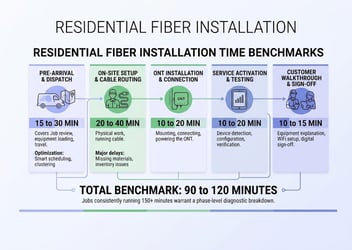
When provisioning takes hours instead of minutes, the technician either waits or leaves. If they leave, you've got a return visit before the customer is live: a second truck roll, a delayed billing trigger, and a customer without working internet on installation day.
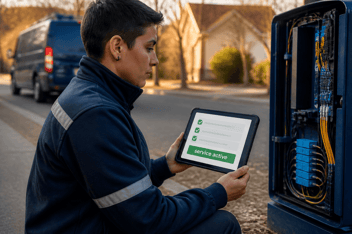
Same-visit activation should be the standard. That means provisioning that finishes quickly on-site, works with the equipment already in the ground, and starts from the technician's mobile device without waiting on the back office.
3. No real-time visibility into the field
When dispatchers can't see where technicians are, how jobs are progressing, or which installs may run long, they're managing reactively. Problems surface by phone call, and by the time anyone knows something is off, the schedule has already broken down.
GPS tracking, mobile job updates, and live status help more than dispatchers. Accountability and support both improve when everyone shares the same view of the day, and mobile workforce management makes that possible at scale.
4. Disconnected systems creating manual handoffs
The most common bottleneck isn't a single tool. It's the gap between tools. When scheduling doesn't talk to provisioning and provisioning doesn't trigger billing, someone has to bridge those steps by hand. Every manual handoff adds a delay, a risk of error, and a task that gets missed when that person is busy.
Connecting scheduling, activation, and billing means the output of one step can trigger the next. That's the core argument for a unified OSS/BSS approach: a connected system where no step waits on a manual trigger.
5. Return visits that should have been prevented
Every unnecessary truck roll points to something upstream: wrong equipment, incomplete job prep, or a provisioning failure nobody caught until the technician arrived. First-time fix rate captures all of it. Improving it usually means fixing things before the technician leaves the warehouse, with accurate job information, the right parts, and verified serviceability.
How do you spot a bottleneck before next year's volume hits?
Test your current process against the volume you're planning for, then look for where work starts to queue. This matters now because 62% of survey respondents expect deployment delays in 2026. A minor annoyance today can stall the whole operation when volume doubles.
| Warning sign | Likely bottleneck | Where to look first |
|---|---|---|
| Technicians start late or drive across territories | Reactive scheduling | Routing and skills matching |
| Finished installs aren't live the same day | Slow provisioning | On-site activation steps |
| Dispatch learns about problems by phone | Poor visibility | Mobile job updates |
| Office staff re-enter job details | Manual handoffs | Links between scheduling, provisioning and billing |
| Repeat visits for missing parts or bad job data | Weak job prep | Inventory and pre-visit checks |
Start with the one causing the most pain today. You don't need a big-bang replacement to scale a live network. You need to remove handoffs one at a time, and to know which metrics will show whether it's working.
Removing the bottlenecks
Most operators tackle these one at a time: better scheduling software here, a faster provisioning tool there. That reduces friction, but the handoffs between systems are still manual. Operators who remove bottlenecks rather than manage them treat field work as part of a connected operation. Scheduling feeds provisioning, provisioning triggers billing, and every step is visible as it happens.
That's what AEX Software and AEX Field Service are built to do, together or on their own. If you want to see how that would work for an operator your size, book a demo.
Frequently Asked Questions
What causes field service bottlenecks in fiber provider operations?
The most common causes are reactive manual scheduling, slow on-site provisioning, no real-time view of field activity, disconnected systems that need manual handoffs, and return visits caused by problems that could have been solved before the technician left the warehouse.
How does automated scheduling reduce field service bottlenecks?
Automated scheduling handles route optimization, skills-based job assignment, and gap-filling when appointments change. With AEX, operators reach 3 to 5 installs per technician per day, a 2-3x improvement.
Why do field service bottlenecks cost fiber operators so much?
Labor is the largest part of fiber deployment cost. The Fiber Broadband Association and Cartesian's 2025 report put it at 72% of underground costs and 64% of aerial, so lost technician time is expensive.
What is first-time fix rate and why does it matter for fiber providers?
First-time fix rate is the percentage of field jobs completed without a return visit. A low rate means more truck rolls, delayed billing, and costs that add up across a growing subscriber base.
How can fiber operators spot bottlenecks before they scale?
Test the current process against planned peak volume and look for where work queues up. Warning signs include late starts, installs not activated the same day, re-entered job details, and repeat visits for missing parts.
What metrics should fiber operators track to identify bottlenecks?
Useful indicators include first-time fix rate, installs per technician per day, provisioning time per job, truck roll frequency, and time from installation to first invoice. Tracking them consistently shows where friction is concentrated.